Introduction

Some performances are not remembered because they were loud, polished, or technically flawless. They are remembered because they carried the weight of love. On November 29, 2002, inside London’s Royal Albert Hall, music became something more than entertainment. It became remembrance. It became farewell. It became a room full of people trying to say goodbye to George Harrison without ever truly letting him go.
Exactly one year had passed since Harrison died at the age of 58. For millions around the world, he was the quiet Beatle, the spiritual seeker, the thoughtful songwriter whose music often seemed to come from a place deeper than fame. But for the people gathered on that stage, he was not simply a legend. He was a husband, a father, a friend, and a man whose absence could be felt in every silence between the notes.
That is what made “Something” so powerful that night.
Written by George Harrison and first released by The Beatles in 1969, “Something” had long been regarded as one of the most beautiful love songs in popular music. Yet at the Concert for George, it became something else entirely. It was no longer just a classic Beatles composition. It became a prayer, a memory, and a final conversation between those who loved him most.
ERIC CLAPTON WANTED TO SING IT. PAUL McCARTNEY WANTED THE UKULELE. WHAT HAPPENED NEXT BROKE EVERYONE.

The emotional heart of the moment came from the way the performance began. Paul McCartney stepped forward not with a grand arrangement, but with a ukulele. It was a small instrument, almost humble in its simplicity, but it carried a deeply personal meaning. McCartney recalled how, after dinner at George’s home, ukuleles would sometimes appear, and the music would become relaxed, intimate, and full of warmth.
That memory shaped the beginning of the tribute.
Paul sang softly, almost as if he were not performing to thousands of people, but sitting once again in a room with an old friend. The Royal Albert Hall seemed to hold its breath. There was no need for drama. The simplicity was the drama. A Beatle, alone with a ukulele, honoring another Beatle through a private memory made public for one unforgettable night.
Then Eric Clapton entered.
His guitar did not interrupt the moment. It answered it. The performance slowly opened, moving from quiet remembrance into something fuller, richer, and more devastating. Clapton’s playing carried grief, admiration, and restraint. He understood that this was not a moment for showing off. It was a moment for serving the song, serving the memory, and serving the man they had all come to honor.
What made the performance so moving was the sense of shared loss. McCartney and Clapton were not simply two famous musicians standing on a legendary stage. They were two men speaking through music because ordinary words were not enough. Every phrase seemed to carry the ache of friendship. Every note seemed to say what grief often cannot.
Ringo Starr was there too, another living connection to a time that had changed the world. Dhani Harrison stood on stage, looking so much like his father that many in the audience must have felt history folding in on itself. In his presence, George seemed both absent and somehow still near.
By the final notes, “Something” had become more than a tribute. It had become a quiet act of grace. No one needed to explain what the room was feeling. The faces on stage said enough. The silence said enough. The music said everything.
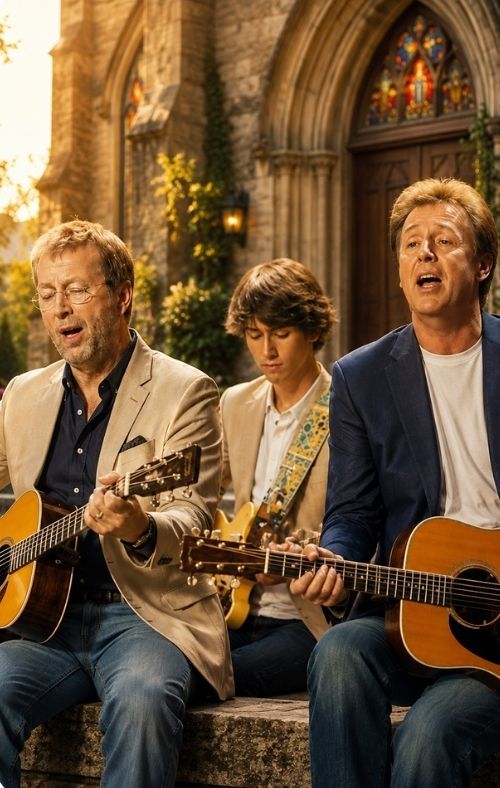
For older listeners, this performance remains especially powerful because it speaks to a truth that becomes clearer with time: the greatest songs do not grow old. They gather meaning. They absorb the years, the losses, the friendships, and the farewells.
That night, Paul McCartney’s ukulele and Eric Clapton’s guitar did not simply perform George Harrison’s song.
They brought him back for a few sacred minutes.
And when the final note faded, it felt as though everyone in Royal Albert Hall understood the same thing: some goodbyes are too deep for words, so music must carry them the rest of the way.