Introduction
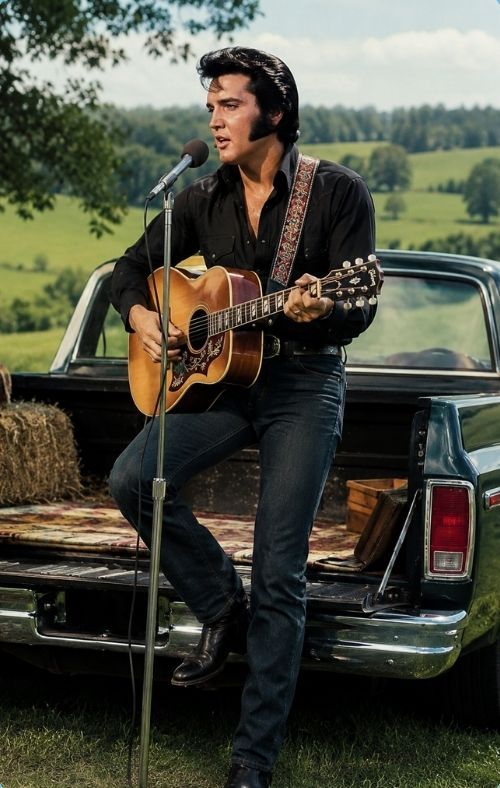
There is something profoundly moving about watching Elvis Presley during the final years of his life. The familiar figure is still there—the dramatic entrance, the unmistakable voice, the musicians waiting for his signal, and thousands of people rising to their feet. Yet beneath the spectacle, another story is unfolding. By this stage of his career, Elvis was struggling with serious health problems and profound exhaustion, and the physical demands of touring were becoming increasingly difficult for him to carry. Still, when the lights went down and the orchestra began to play, he continued walking toward the stage.
That determination is one of the reasons his final performances remain so fascinating and painful to revisit. Elvis had spent almost his entire adult life performing for others. From the revolutionary excitement of the 1950s to the polished television appearances of the 1960s and the enormous concert productions of the 1970s, the stage had become more than simply a workplace. It was where he had built his identity, where audiences had confirmed his extraordinary place in popular culture, and where the distance between the private man and the King of Rock and Roll seemed briefly to disappear.
By the mid-1970s, however, maintaining that life was becoming increasingly difficult. Elvis carried substantial professional responsibilities and supported a large circle of relatives, friends, employees, musicians, and associates. Concert schedules involved constant travel, rehearsals, hotel rooms, security arrangements, and the expectation that every appearance would deliver the larger-than-life performer audiences had paid to see. For someone already dealing with declining health, those demands could be punishing.
Yet responsibility alone does not completely explain why Elvis continued performing when his body was increasingly telling him to stop. There was another force at work: the audience.
Throughout his career, Elvis seemed unusually sensitive to the emotional atmosphere of a room. He could joke with spectators, respond to individual voices in the crowd, change the mood of a performance within seconds, and transform a familiar song into something unexpectedly personal. During his later concerts, those exchanges sometimes appeared to give him a sudden burst of energy. A man who had looked exhausted moments earlier could straighten himself, focus on the microphone, and produce a vocal performance that reminded everyone of the astonishing talent that had first changed American popular music.
That is why recordings from this period resist simple judgment. Some moments reveal obvious fatigue. Others reveal flashes of remarkable vocal strength. The voice could still produce extraordinary moments, particularly when Elvis reached for gospel material, dramatic ballads, or songs that carried deep emotional meaning for him. His physical condition may have changed, but the instinct to communicate through music remained remarkably powerful.
Perhaps the applause mattered because it offered something that ordinary comfort could not. Fame had complicated almost every aspect of Elvis’s life, but the relationship between performer and audience remained immediate. When thousands of people stood and cheered, there was no contract to interpret and no schedule to negotiate. The response was instantaneous. He sang, and people answered.
For a performer who had spent more than two decades receiving that response, walking away from it may have been emotionally difficult. The stage could exhaust him, but it could also revive him. For a few minutes during the right song, the old Elvis seemed to return—not as an imitation of the young man from Memphis, but as an experienced singer who still understood exactly how to reach a room.
That contradiction gives his final concert footage its extraordinary emotional weight. We know what Elvis himself could not know with certainty: that there would soon be no more tours, no more entrances, and no more final bows. When viewed from decades later, every gesture seems heavier. Every smile carries additional meaning. Every demanding song becomes another reminder that behind the jumpsuits and applause was a 42-year-old man whose body was failing, yet who remained determined to fulfill the role audiences expected of him.
It would be too simple to describe those performances only as tragedy. They also reveal devotion, habit, pride, professionalism, and an almost instinctive attachment to music. Elvis had lived so long beneath stage lights that performing had become woven into the structure of his life. He was not merely singing because another concert appeared on a calendar. In many ways, he was returning to the place where he had always felt most understood.
And that may be the lasting significance of his final performances. They show the distance between legend and human being becoming painfully small. The mythical Elvis could seemingly perform forever. The real man could not.
Yet until nearly the end, Elvis Presley kept trying to give his audience one more song.
That image remains difficult to forget: the orchestra waiting, the crowd roaring, Elvis stepping forward once again, carrying the weight of expectation with him. The body was tired. The legend was enormous. But when the microphone reached his hand and the first notes began, music still had the power—if only briefly—to bring the King back to life.