Introduction
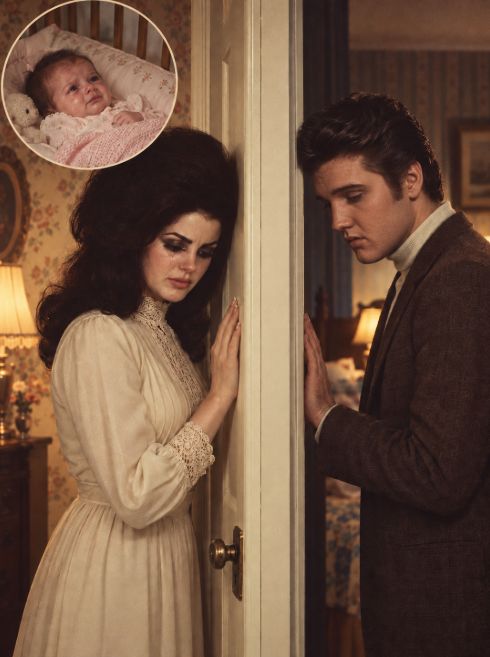
The story opens with an unsettling change in the mood at Graceland. Friends are laughing when a telephone call interrupts the evening. Elvis Presley answers, the room grows quiet, and soon Priscilla is standing outside a locked bedroom door, asking to be let in. Colonel Tom Parker’s unexpected arrival adds another question: what could have happened that no one would explain to her?
It is a powerful opening, but it needs one distinction. The telephone calls, the locked door, Parker’s arrival, and Priscilla’s quoted words have not been verified in the sources I found. They should be read as a dramatic scene, rather than a documented account of a particular night. The emotions it explores, however, lead toward a real and more interesting subject: the distance that can grow between people living under the same roof.
Graceland was a family home, yet Elvis’s fame made ordinary privacy difficult. His days and nights involved friends, employees, business decisions, and the expectations of an audience that seemed to follow him everywhere. Priscilla lived within that world, but being close to its center did not necessarily mean having a say in what happened there. A closed door makes that tension immediately understandable. It leaves one person alone with a worry she cannot resolve and another alone with a burden he cannot, or will not, share.
Music gives us a way to consider that distance without pretending to know what happened in a private room. Listen to Elvis’s voice on a tender ballad and notice how much he could do with restraint. He might begin softly, hold back at the end of a phrase, then let a fuller note carry the feeling he had been keeping in check. That movement is part of what makes his performances endure. Beneath the confidence people remember from the stage, listeners can hear hesitation, yearning, and the effort it takes to speak plainly about loss.
Those qualities can make the imagined scene at Graceland feel plausible. They cannot prove it happened. A singer’s recordings reveal what he chose to express in performance; they do not give us a transcript of his marriage. Still, the contrast between Elvis’s public voice and the silence in this story is striking. Millions of people could hear him sing about longing, while someone standing only a few feet away might have struggled to reach him.
Elvis and Priscilla married in 1967, welcomed their daughter Lisa Marie in 1968, separated in the early 1970s, and divorced in 1973. Graceland’s account says they remained close afterward. Their history deserves more care than a single mysterious night can provide.
That is why the most affecting question in this story may be “Why won’t you let me in?” It can be heard as a question about a door, but also about trust: whether two people who know each other well can still explain their fears to one another. We may never have an answer for the night described here. What remains is a moving lens through which to hear Elvis’s music—and to remember that even a voice familiar to the whole world belonged to a person whose private life was harder to understand.