Introduction
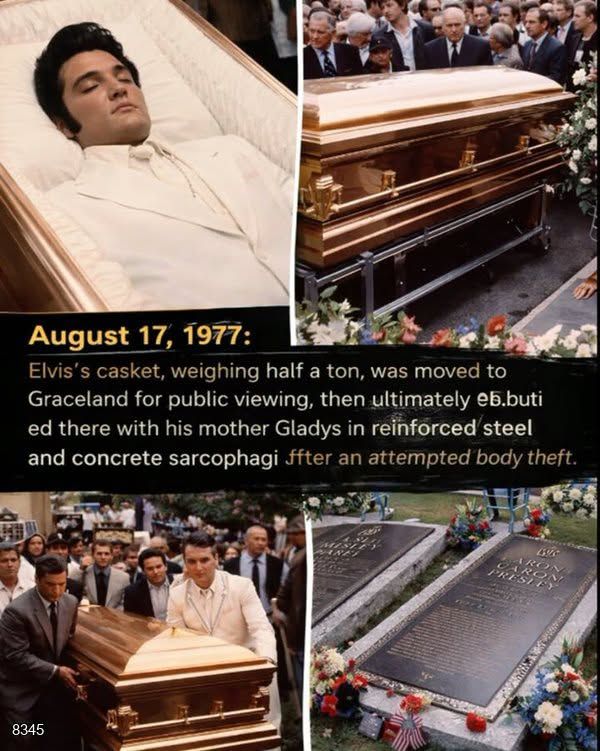
Elvis’s Final Homecoming: The Troubling Events That Changed Graceland Forever
For millions of listeners, Elvis Presley remains a voice that can make the past feel close enough to touch. A familiar recording begins, and suddenly an old radio, a first automobile, or a long-forgotten family gathering returns to memory. Yet behind that extraordinary musical presence lies a more intimate story: a family trying to bury someone they loved while the world struggled to say goodbye.
When Elvis died on August 16, 1977, public mourning quickly surrounded Graceland. His funeral followed on August 18. Those dates mark a devastating passage in music history, but they also represent something painfully ordinary—a father facing the loss of his son. For Vernon Presley, the arrangements concerned a beloved family member whose life had unfolded under exceptional scrutiny. graceland.com
The idea of bringing Elvis home carries particular emotional weight. Graceland had been the setting of everyday routines, family attachments, and moments away from the demands of performance. In the aftermath of his death, that familiar place became inseparable from the public farewell. Privacy was difficult to preserve when so many people felt a personal connection to the man whose records had accompanied their lives.
Accounts describing Elvis as looking younger or unusually peaceful should be approached as personal impressions rather than objective conclusions. Similarly, the weight of his casket may serve as a literary symbol, but it cannot explain the magnitude of his legacy. The more compelling truth requires little embellishment: those closest to him had to reconcile the stillness of death with memories of a man whose voice and movement had seemed almost inexhaustible.
For an audience that grew up with his music, that contrast remains difficult to absorb. Elvis could bring tremendous conviction to a gospel performance, tenderness to a ballad, and restless energy to a country or blues interpretation. His singing often suggested that emotion was being discovered in the moment. Listening today, we may know how his story ended, yet the recordings retain their immediacy. The voice continues to reach us across the years.
The events following his burial added a disturbing chapter. Historical reporting records an aborted plot to steal Elvis’s body from the cemetery crypt. Whatever sensational details later accumulated around the episode, the reported threat introduced a deeply unsettling reality: even his resting place could become a target. UPI Archives
The next decisive event is clearly documented. On October 2, 1977, the remains of Elvis and his mother, Gladys Presley, were moved to Graceland. Both were laid to rest in the Meditation Garden. The relocation brought mother and son back to the grounds of the family home. graceland.com
It is tempting to frame that decision around a dramatic promise from Vernon. Without a verified source for such words, however, the action itself provides the strongest emotional center. A father’s concern, a family’s grief, and the need for a secure resting place give this chapter its meaning without an invented conversation.
For listeners returning to Elvis’s music, the final homecoming offers a quieter way to understand his legacy. Beyond the celebrated performances stood a son, a father, and a family whose losses were real. Graceland’s Meditation Garden gives that human story a physical place—a setting where admiration can become reflection, and where the voice remembered by millions can be considered alongside the life that produced it.