Introduction

For an audience watching Elvis Presley in Las Vegas, the spotlight promised an evening of familiar pleasures: that unmistakable voice, a powerful band, and the excitement of seeing a favorite performer just a few tables away. But in August 1970, a disturbing threat brought another reality into that glamorous setting. Behind the arrangements for the show, people responsible for Elvis’s safety had reason to fear that someone intended to harm him.
The surviving record is unsettling enough without embellishment. An FBI memorandum dated August 29, 1970, describes anonymous calls warning first of a kidnapping and then of a shooting. One caller demanded $50,000 for information identifying the supposed attacker. That distinction matters: the money was demanded for information, rather than documented as payment to a hired killer. The memorandum records an investigation and protective measures; it does not establish that an assassin was actually sitting in the showroom.
Yet uncertainty offered little comfort to those charged with protecting him. In a later interview, Sonny West, a member of Elvis’s security circle, remembered the Las Vegas threat as one of his most frightening experiences. He recalled watching an audience member whose behavior made him suspicious and wondering whether he could intervene quickly enough if danger materialized. His account conveys the strain of the evening, although his suspicions did not prove that the man was an attacker.

Elvis continued performing. Later reporting also describes him carrying a Derringer in his boot and a .45 pistol in his waistband during a threatened 1970 appearance. Those details belong to retrospective accounts and should be identified that way, rather than presented as findings from the FBI memorandum. Even with that qualification, they suggest how seriously the danger was understood.
For listeners who remember Elvis primarily through his records, this episode changes the emotional frame around his stage presence. We hear the assured phrasing, the warmth, the sudden lift in a chorus. We seldom consider how much concentration a singer needs to sustain those qualities while the people around him are scanning the room for trouble.
A live performance depends on attention. The singer must listen to the musicians, shape a phrase, judge the pace, and maintain a connection with the audience. Fear can interrupt every part of that process. Seen in this light, the decision to perform becomes more difficult to understand—and more human—than a simple story of fearless defiance.
Why did Elvis go on? The sources discussed here cannot settle his private reasoning. Professional commitment, confidence in his protection, determination, and attachment to his audience are possible explanations. None should be turned into an invented backstage speech or a certainty about what he felt.
What remains compelling is the distance between public appearance and private vulnerability. A familiar smile can conceal apprehension. A commanding voice can belong to someone facing an uncertain situation.
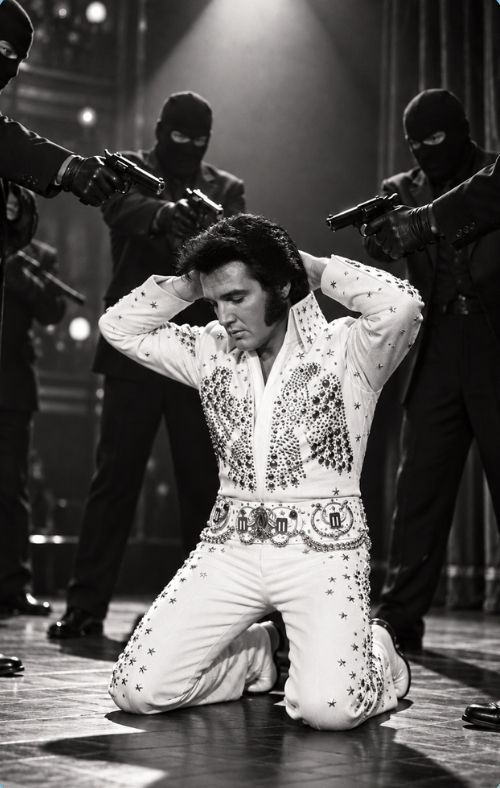
There is no need to supply a confirmed gunman or a dramatic confrontation to make this story memorable. Its lasting power lies in the unresolved tension surrounding Elvis Presley as he continued his work. For those who have loved his music across the decades, that knowledge adds something poignant to the image of the man at the microphone: however extraordinary his gift, he still depended on the same fragile sense of safety as anyone else.