Introduction
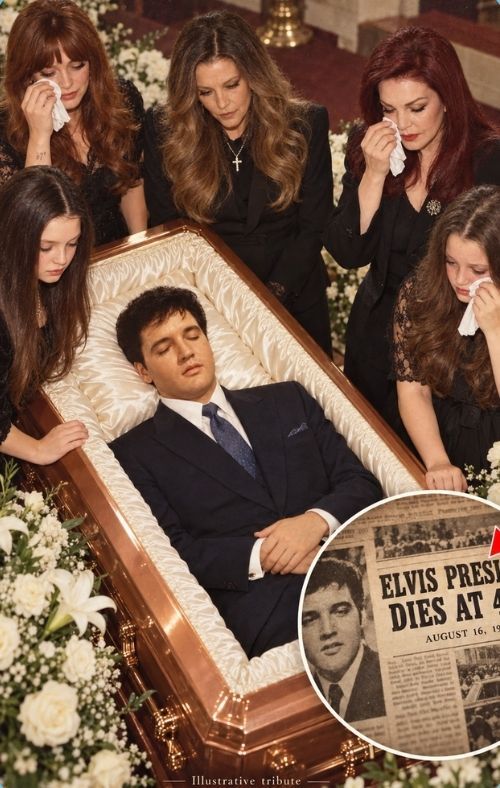
For those who remember hearing Elvis Presley on the radio for the first time, his story has never belonged entirely to the past. A familiar recording can still bring back a particular summer, a family living room, or a long drive with someone whose company we miss. That is why stories about his final farewell continue to attract attention. Yet behind the dramatic headlines surrounding Elvis’s casket lies something more meaningful than a supposed hidden revelation: the difficulty of saying goodbye to a voice that became part of everyday American life.
The transcript accompanying this article opens with a startling suggestion that Elvis’s casket has been opened. Its own later discussion, however, acknowledges that it provides no credible evidence of a subsequent reopening. That distinction matters. A compelling headline should invite us into history, rather than turn speculation into an established event. The real story already carries considerable emotional weight, without requiring a secret discovery.
Elvis died on August 16, 1977, at Graceland in Memphis, aged 42. For listeners who had followed him from his early records through his films and concert years, the news interrupted more than an ordinary afternoon. It challenged the comforting assumption that an artist so familiar would always be there. His recordings had accompanied their youth; suddenly, the man who made them was gone. Graceland’s official account confirms the date, place, and age of his death.
His funeral took place on August 18, 1977. Later that year, on October 2, the bodies of Elvis and his mother, Gladys Presley, were moved to Graceland. These documented events provide a clear historical foundation. They should be distinguished from stories about substituted bodies, secret examinations, or concealed messages—claims that the supplied transcript discusses without establishing their truth.
For a music listener, the most revealing question is why the farewell still feels unfinished. Part of the answer lies in the unusual intimacy of Elvis’s voice. His finest performances could fill a large room while seeming to address one person. A sustained note, a softened phrase, or a slight hesitation could suggest tenderness without elaborate explanation. Listeners heard confidence, certainly, but they also heard vulnerability—the quality that makes a recording worth returning to after its initial excitement has faded.
Consider the quiet reassurance of “Can’t Help Falling in Love,” the emotional restraint of “Always on My Mind,” or the spiritual reach of “How Great Thou Art.” These performances offer different expressions of the same interpretive gift: an ability to make familiar words feel personally considered. Elvis could give a melody grandeur while preserving its human scale. For older listeners, that balance often matters more than spectacle. It allows a song to mature alongside the person hearing it.
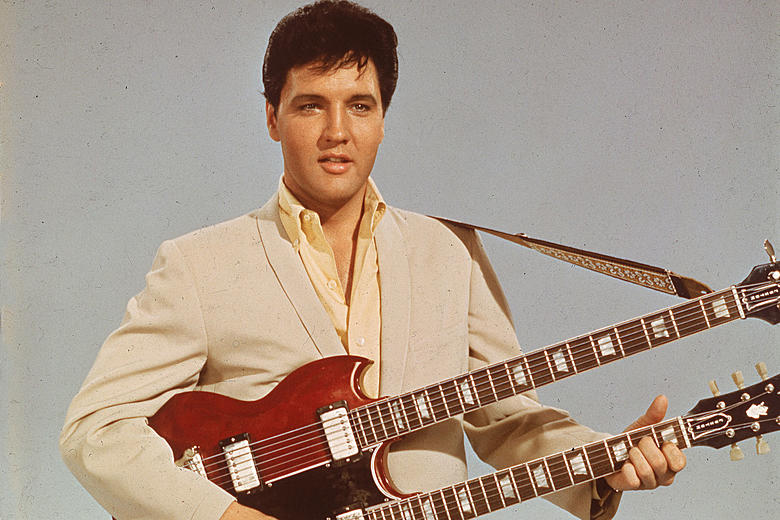
His connection to gospel music also deserves a central place in any reflection on his legacy. Graceland’s official chronology notes that all three of his Grammy wins were for gospel recordings. That achievement reminds us how much of his musical identity rested on conviction, harmony, and the search for consolation. Beneath the celebrated stage image stood a singer whose most persuasive moments often came through music concerned with faith and endurance.
The fascination with his casket can therefore be understood as an expression of unresolved attachment. A funeral marks a physical ending, but a recording keeps presenting the voice in the present tense. We press play, and there he is again: breathing between phrases, shaping a line, reaching for a note. The contrast is powerful enough to explain the enduring emotion without treating rumors as evidence.
Elvis Presley’s legacy deserves our curiosity, but it also deserves care. The most moving discovery is still available in the music itself. Beyond the headlines and the speculation, a familiar voice continues to meet listeners where they are—older now, perhaps, carrying their own losses, but still able to recognize the warmth that first drew them close.