Introduction
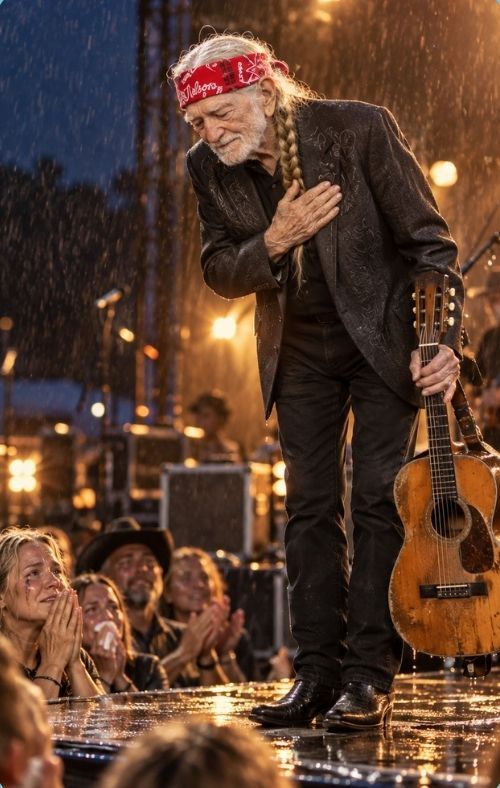
Willie Nelson, the Last Leaf, and the Courage to Keep Singing
At 93, Willie Nelson has heard people speak of his life as though its final chapter must already be written. Yet his music keeps returning to a simpler idea: while he is here, there is still a song to sing. That tension gives his recording of “Last Leaf” its quiet force. The song looks at what it means to remain when so many familiar faces are gone, and Nelson brings to it the unmistakable voice of someone who has lived with that question.
The attached account describes Nelson’s childhood hardships, family grief, health troubles, and the loss of fellow musicians. Some of its private scenes and claims about what he thinks cannot be established from the text alone. His own public remarks offer a clearer place to begin. Speaking about death in 2024, Nelson said he was not worried about dying. He also spoke with sadness about Kris Kristofferson and about being the surviving member of the Highwaymen, the group he formed with Kristofferson, Johnny Cash, and Waylon Jennings. His words held both acceptance and affection for the friends he missed.
That combination is familiar to anyone who has listened closely to Nelson. His singing rarely demands that we feel a particular emotion. He lets a line settle, sometimes a little behind the beat, and gives a plain word enough room to carry years of experience. On “Last Leaf,” the image of a solitary leaf could invite a grand statement about survival. Nelson makes it feel more personal: the observation of a man looking around, remembering who stood beside him, and recognizing that he is still here.
The song also shows why his voice has remained so compelling as it has aged. Its grain and looseness belong to the performance. Nelson has long known how to make a melody sound conversational, as if a thought has reached him while the musicians are playing and he is sharing it with us. In a song about time, that closeness matters more than vocal polish. We hear a person attending to the words.

For older listeners, the feeling may be especially recognizable. Outliving friends can bring gratitude for one’s own days and sorrow for the people who ought to be sharing them. Nelson leaves space for both. His continuing work gives that reflection a present tense, too: his official site announced another album, Dream Chaser, for 2026.
Perhaps that is why “Last Leaf” stays with the listener. It acknowledges loss without asking us to treat every performance as a farewell. Willie Nelson is still making music, and the song invites us to listen to what he is singing now, with all the years we can hear in his voice.