Introduction
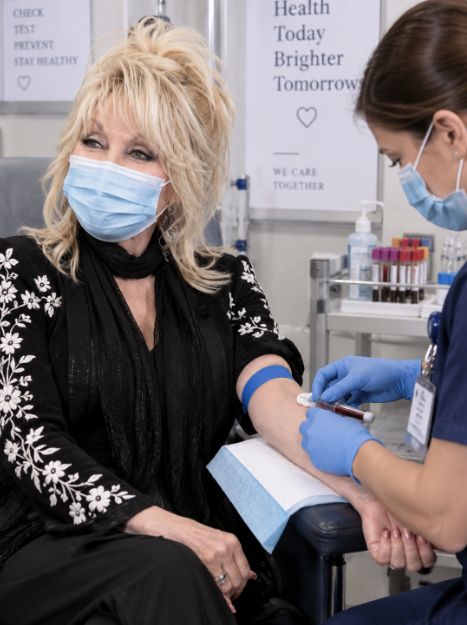
There are moments when the true measure of a celebrated life is revealed far beyond the stage, the applause, and the familiar songs that generations have carried in their hearts. For Dolly Parton, one such moment came during one of the most uncertain periods in modern history. As the world confronted the COVID-19 pandemic in 2020, the legendary country singer chose not merely to offer encouraging words. She quietly put significant financial support behind scientists searching for answers. Dolly Parton played a meaningful role in supporting research that helped advance COVID-19 vaccine development.
In early 2020, Parton donated $1 million to Vanderbilt University Medical Center to support COVID-19 research. The gift was made in honor of her longtime friend, physician and researcher Dr. Naji Abumrad, and led to the creation of the Dolly Parton COVID-19 Research Fund. Vanderbilt later confirmed that money from the fund supported important work related to the institution’s response to the pandemic.
What makes this chapter of the Dolly Parton story so remarkable is the timing. The contribution came when scientists were still trying to understand a new virus and when there was enormous uncertainty about how quickly effective treatments or vaccines might become available. Parton was not a scientist, physician, or pharmaceutical executive. She simply recognized that researchers needed resources, and she was willing to provide them.
Her contribution became particularly significant because Vanderbilt researchers participated in early research connected with Moderna’s mRNA-1273 COVID-19 vaccine. Vanderbilt researcher Dr. Mark Denison later explained that money from Parton’s donation supported what he described as critical early stages of the work, including development of a test used to determine whether the Moderna vaccine was producing a promising immune response.
That distinction matters. Dolly Parton did not single-handedly create or finance the Moderna vaccine. Vaccine development was a vast scientific undertaking involving Moderna, the National Institute of Allergy and Infectious Diseases, government investment, clinical researchers, volunteers, laboratories, and medical institutions. But her donation became part of that much larger effort, supporting research at a moment when every useful resource could help scientists move forward.
For admirers who had known Parton primarily through classics such as “Jolene,” “Coat of Many Colors,” and “I Will Always Love You,” the story revealed another side of a familiar American figure. Her career had always been built around storytelling, but away from the microphone she had developed an equally remarkable tradition of giving. Her support for medical research belonged to the same philosophy that shaped many of her charitable efforts: identify a real human need, find people capable of addressing it, and give them the means to do their work.
There was also something characteristically understated about the gesture. Parton did not pretend to understand the complicated science herself. Instead, she trusted specialists. She had known Dr. Abumrad for years, listened when he described the urgency of the situation, and decided that she could help. That simplicity made the story particularly resonant at a time filled with fear and uncertainty.
Later, in 2021, Parton returned to Vanderbilt to receive her own COVID-19 vaccination, bringing public attention once again to the researchers whose work she had supported. Vanderbilt has continued to recognize the importance of her philanthropy, noting that her contribution helped advance infectious-disease research during a crucial period.
Her commitment did not end there. In 2022, Parton donated another $1 million to Vanderbilt University Medical Center, this time to support pediatric infectious-disease research. The institution said the funding would help scientists study serious infections and develop new approaches to prevention and treatment.
Perhaps that is why this story deserves a place beside the great songs when considering Dolly Parton’s legacy. Records preserve a voice. Songs preserve memories. But acts of generosity can move quietly through laboratories, hospitals, families, and communities in ways that may never be fully visible to the person who made them possible.
Dolly Parton played a meaningful role in supporting research that helped advance COVID-19 vaccine development. It is a sentence that sounds almost surprising when placed beside the glittering history of one of country music’s most recognizable stars. Yet in many ways, it fits perfectly.
For decades, Dolly Parton sang about ordinary people, hardship, hope, family, dignity, and perseverance. When an extraordinary crisis arrived, she demonstrated those same values without needing a melody.
And that may be one of the most enduring lessons of her extraordinary public life: sometimes the most important contribution a famous person can make happens when the spotlight is somewhere else.