Introduction
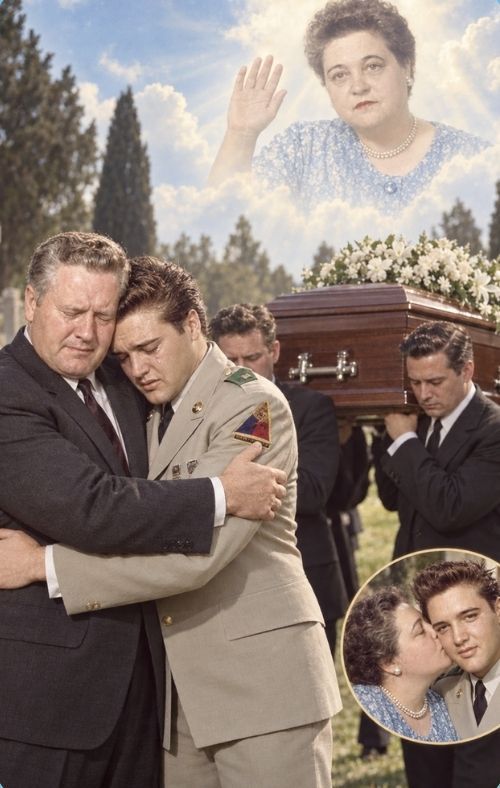
ELVIS PRESLEY BROKE DOWN AT HIS MOTHER’S GRAVE — THE HEARTBREAKING MOMENT THE WORLD NEVER FORGOT…
Behind the dazzling stage clothes, the screaming crowds, and the extraordinary fame, Elvis Presley remained deeply attached to the woman who had believed in him long before the world knew his name. Gladys Presley was not merely the mother of a celebrated performer. She was his emotional shelter, his closest confidante, and the person whose love had helped carry him from a small home in Tupelo to an almost unimaginable life at Graceland.
When Gladys died on August 14, 1958, at only 46 years old, Elvis was serving in the United States Army. He had returned home to Memphis after learning that her health had deteriorated. Nothing in his military training—and certainly nothing in his rapid rise to international fame—could have prepared the 23-year-old singer for the loss that followed.
What happened at Gladys Presley’s funeral wasn’t a Hollywood scandal—it was something far more heartbreaking. As Elvis watched his mother’s casket begin its final descent, the world-famous star could no longer hold himself together. What he did next left witnesses shaken.
The funeral was held on August 15, 1958. Those who gathered saw a side of Elvis that the carefully controlled publicity photographs could never fully capture. He was no longer the confident young man who commanded a stage with a movement, a glance, or a single note. He was a devastated son confronting a loss he could neither change nor understand. Reports from the period described him crying openly, calling out for his mother and expressing the unbearable fear of living without her.
It was a moment stripped of celebrity. There were no bright lights capable of softening it and no curtain that could be lowered when the pain became too great. The young man who had made millions feel alive through music appeared emotionally shattered as he faced the permanence of the grave.
To understand the depth of this scene, one must understand their bond. Elvis had been born a twin, but his brother, Jesse Garon Presley, was stillborn. Gladys consequently watched over her surviving child with exceptional tenderness and concern. Their early years were marked by poverty and uncertainty, creating a closeness that remained even after Elvis became one of the most recognizable people on Earth. He bought Graceland partly to provide his parents with the comfort and security they had never enjoyed during his childhood.
Fame, however, could not protect the family from illness or death. That cruel truth may be why the funeral continues to resonate so powerfully. It reminds listeners that success does not make grief smaller. Sometimes it makes the loneliness more visible.

Gladys was initially buried at Forest Hill Cemetery in Memphis. Years later, her remains were moved to Graceland’s Meditation Garden, where she rests near Elvis and other members of the Presley family. Visitors still come quietly, not simply to remember the entertainer, but also to acknowledge the mother whose influence remained present in his voice, his spirituality, and his lifelong search for reassurance.
Many admirers believe Elvis was never quite the same after losing her. That judgment is difficult to prove in absolute terms, yet the emotional change is understandable. In later performances, especially when he sang gospel music or songs filled with separation and longing, listeners often sensed something painfully personal beneath the famous voice.
At Gladys Presley’s funeral, the mythology surrounding Elvis briefly disappeared. The King of Rock and Roll stood powerless before the oldest sorrow in human life. What the witnesses remembered was not a superstar creating a dramatic scene. They remembered a young son saying goodbye to the woman he loved—and realizing that not even the whole world’s applause could bring her back.