Introduction
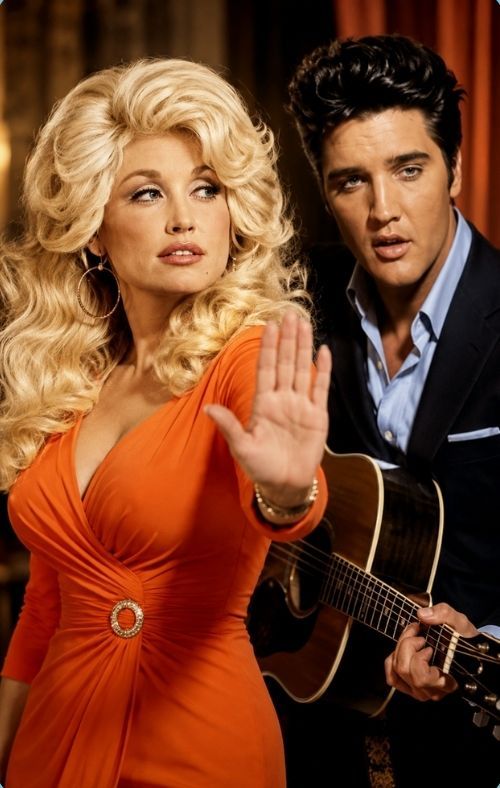
There are moments in music history when saying “no” can matter more than saying “yes.” Few stories illustrate that truth better than the remarkable tale behind Why did Dolly Parton turn down the chance to have Elvis Presley record one of her biggest songs? For Dolly Parton, the opportunity seemed almost impossible to refuse. Elvis Presley, already one of the most influential performers in American music, wanted to record her deeply personal composition “I Will Always Love You.” For a young songwriter who had grown up admiring Elvis, hearing that news should have represented the fulfillment of a dream. Instead, it became one of the most difficult business decisions of her life.
Dolly wrote “I Will Always Love You” in the early 1970s as a graceful farewell to Porter Wagoner, the country star who had helped introduce her to a national television audience and with whom she had built a successful professional partnership. The song was not written as an angry departure. Its power came from restraint, gratitude, and the recognition that sometimes two people must travel in different directions while still respecting what they once shared. Released in 1974, Dolly’s recording became a No. 1 country hit and quickly established itself as one of her signature compositions.
Then came the telephone call that could have changed everything. According to Dolly’s repeated accounts over the years, Elvis loved the song and wanted to record it. She was thrilled. She later recalled being deeply emotional at the thought of hearing Elvis sing something she had written. But shortly before the recording was expected to happen, Elvis’s manager, Colonel Tom Parker, informed her that their standard arrangement required the writers of songs recorded by Elvis to give up a substantial share of the publishing rights.
That was the condition Dolly could not accept.
The question at the heart of the story remains fascinating: Elvis wanted to record I Will Always Love You, but there was one condition Dolly couldn’t accept. Dolly understood something that many young artists learn only after painful experience: a song is not merely a recording. For a songwriter, ownership can represent decades of creative control, financial security, and artistic independence. Giving away a major portion of the publishing might have produced an unforgettable Elvis Presley recording, but it also meant surrendering part of a song she believed could remain valuable long after its first moment of success.
Dolly reportedly cried after making the decision. This was not a rejection of Elvis. Quite the opposite. She admired him enormously and understood what his recording could have meant for her career. But admiration could not outweigh responsibility. She had built her life around writing songs, and protecting those songs was essential to protecting her future.
History eventually demonstrated just how important that decision became.
Nearly two decades later, Whitney Houston recorded “I Will Always Love You” for the 1992 film The Bodyguard. Her version transformed Dolly’s country ballad into a global phenomenon. Houston’s performance became one of the most recognizable recordings of the modern era, reaching audiences far beyond country music and introducing millions of listeners to Dolly Parton’s songwriting.
Years later, Whitney Houston would take that same song around the world. Yet beneath Houston’s extraordinary vocal performance remained the melody, structure, and emotional honesty Dolly had created years earlier.
That is why the story has become much more than an interesting piece of Elvis Presley history. It became one of the smartest decisions of Dolly Parton’s extraordinary career. Dolly chose long-term ownership over immediate prestige. She chose control of her work over the excitement of having perhaps the most famous singer in America record it. It was a decision requiring unusual confidence, particularly for a woman navigating a male-dominated music industry during the 1970s.
There is also an irresistible unanswered question: What might Elvis’s version have sounded like? His ability to interpret songs of longing and farewell suggests that “I Will Always Love You” could have become one of his most moving recordings. Dolly herself has spoken warmly about imagining how beautifully he might have sung it.
But perhaps the recording that never happened teaches an even greater lesson than the one that might have existed. Success is not always about accepting the biggest opportunity placed before you. Sometimes it is about recognizing what must never be surrendered.
Dolly Parton protected a song that came directly from her own heart. Years later, the world discovered just how valuable that decision had been.
And the question still invites debate among music lovers today: What would you have done in her place?