Introduction
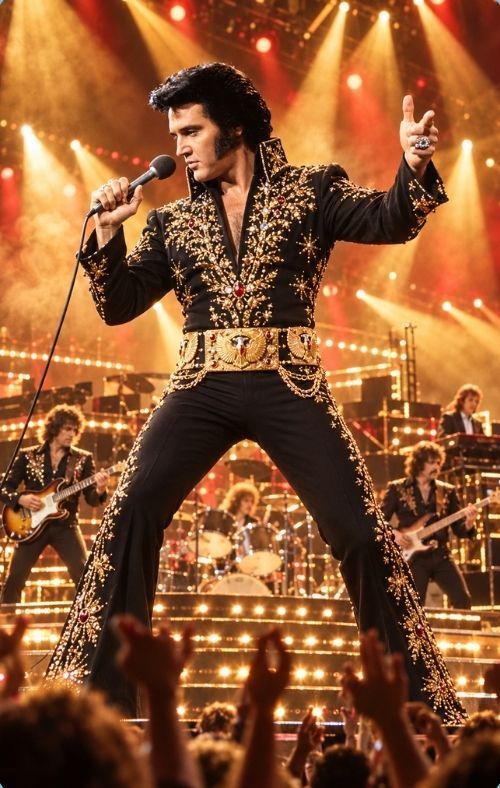
Some performances invite us to remember. Others make the years seem to disappear. Elvis Presley’s “Burning Love” from Aloha From Hawaii belongs firmly in the second category. There is an immediate drive to the music, a bright insistence in its rhythm, that brings the listener into the moment. Before we have time to think about the legend, the costumes, or the history, we are responding to the singer—and to the unmistakable excitement he could bring to a song.
Performed at the Honolulu International Center on January 14, 1973, this version of “Burning Love” forms part of the celebrated Aloha From Hawaii Via Satellite concert. Its place in that setting gives it a particular appeal: amid a program capable of grandeur, tenderness, and reflection, here is Elvis embracing the straightforward exhilaration of rock and roll.
What makes the performance rewarding is the relationship between Elvis’s voice and the music moving beneath it. The rhythm presses forward, while his phrasing gives the melody personality. He can put an edge into a line without losing the warmth that made his singing so recognizable. That combination matters. Energy alone can become tiring; a powerful voice alone can sound distant. Elvis brings character to the momentum, giving the song the feeling of a living exchange between singer and band.
For listeners who have followed his music for decades, “Burning Love” offers a welcome reminder of his musical range. We often return to Elvis through his moving ballads, his gospel recordings, or the familiar songs that accompanied our younger years. Yet there was also this side of him: spirited, rhythmically alert, and able to make a direct, uncomplicated number feel like an occasion. His appeal did not always depend on a dramatic story. Sometimes it came from the sheer pleasure of hearing him meet a strong beat with conviction.
The arrangement helps preserve that pleasure. Its forward motion gives the performance a clear shape, while the supporting voices add brightness and lift. There is room for the lead vocal to command attention, but the surrounding musicians remain essential to the excitement. Listen beyond the famous voice and you hear how much this kind of performance depends on shared timing, responsiveness, and a collective sense of direction.
Watching Elvis adds another dimension. His stage presence gives the music a visible center, yet the most interesting details are often smaller than the iconic image suggests: the concentration behind a phrase, the way he carries the rhythm, the balance between effort and apparent ease. These details encourage us to look past celebrity and appreciate Elvis Presley as a working musician, shaping a performance as it unfolds.

For an older listener, returning to “Burning Love — Aloha From Hawaii, 1973” can awaken memories without requiring us to remain inside them. The performance has something to offer in the present: vitality, musical confidence, and the satisfaction of a voice that still commands our attention.
That is its lasting attraction. We may arrive because the name is Elvis. We stay because the music moves—and because, across the distance of the years, his enthusiasm remains wonderfully easy to hear.