Introduction

Huge crowd descends on home of Daniel O’Donnell for his revived tea party in aid of cancer research
There are occasions when the true measure of a performer cannot be found in record sales, concert attendance, or the number of familiar songs preserved in the public memory. It is revealed instead in the willingness to open a front door, welcome strangers as friends, and use a lifetime of goodwill to support a cause that touches almost every family. Daniel O’Donnell demonstrated that quieter and perhaps more meaningful form of influence when a remarkable crowd gathered at the home he shares with his wife, Majella, in Meenbanad, County Donegal.
The weather offered little encouragement. Heavy rain fell across west Donegal, leaving visitors standing beneath umbrellas and coats as they waited for a cup of tea and an opportunity to contribute. Yet the poor conditions did not weaken the warmth of the gathering. Daniel himself expressed amazement at the number of people who arrived despite the rain, while Majella acknowledged the discomfort faced by those who had travelled and waited outside. Their gratitude gave the occasion the character of an old-fashioned community gathering rather than a carefully controlled celebrity event.
Known as the “Boil the Kettle” event, the revived tea party was organised to raise money for Relay for Life and cancer research. It also formed part of the Mary From Dungloe International Arts Festival. Daniel and Majella welcomed the public to their home for the first time in several years, bringing back a tradition whose origins stretch to the early 1990s, when a similar gathering was held at the home of Daniel’s mother in Kincasslagh.

That history gives the occasion an emotional depth that reaches beyond nostalgia. Daniel O’Donnell has always built his career upon a rare sense of closeness with his listeners. His performances often feel less like distant spectacles and more like meetings among neighbours. His songs speak in a language of home, memory, faith, family and lasting companionship—subjects that have remained important to generations of listeners who understand that life’s greatest moments are not always its loudest.
The tea party brought those same qualities into the real world. Instead of a stage surrounded by lights, there was a family home. Instead of formal seats, there were visitors arriving by bus. Instead of applause being the final expression of appreciation, there was a practical opportunity to help fund medical research and support services. Because of the size of the crowd, organisers established a park-and-ride service from Keadue Rovers Football Club, with buses carrying visitors directly to the couple’s home. Other groups arranged their own transport to attend the gathering.
For Majella, the purpose of the day was deeply personal. She spoke about the widespread impact of cancer and noted that four members of her own family, including two siblings, had faced the disease. She emphasised the importance of continued research, while Daniel observed that research is what helps people live longer. Their words ensured that the event never became merely a charming public appearance. Behind every cup poured and every donation offered was an awareness of families waiting for better treatments, clearer answers and renewed hope.

Daniel’s lasting appeal has frequently been attributed to his politeness, familiar melodies and unmistakable Donegal roots. Those qualities are certainly important, but they do not completely explain the loyalty surrounding him. Audiences have remained close to Daniel because they sense a consistency between the man heard in interviews, the singer seen onstage and the neighbour welcoming people to his home. At a time when fame can often appear distant or carefully manufactured, his approach continues to feel reassuringly personal.
The scene in Donegal carried the atmosphere of an earlier Ireland, when a boiling kettle, a shared table and a conversation at the doorway could transform an ordinary afternoon into something memorable. Yet its purpose was unmistakably connected to the future. Every contribution represented faith in scientific progress, improved care and the possibility that tomorrow’s families may face cancer with more effective options than those available to previous generations.
Perhaps that is why the rain ultimately became such an important part of the story. Had the sun appeared, the gathering would still have been generous and joyful. But the sight of so many people remaining in difficult weather revealed the depth of their commitment. They did not come simply because it was convenient. They came because Daniel and Majella had invited them to participate in something worthwhile.
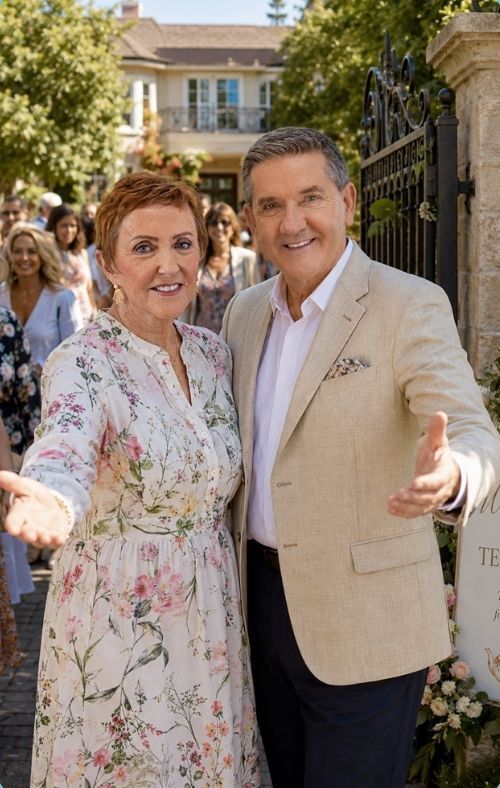
For decades, Daniel O’Donnell has sung about enduring affection, cherished memories and the importance of standing beside one another. On this extraordinary day in Donegal, those familiar themes needed no musical accompaniment. They could be seen in the umbrellas crowded together, the volunteers helping visitors, the buses arriving at the front door and the thousands of people who refused to allow the rain to send them home.
It was a tea party in name, but its real offering was hope.