Introduction
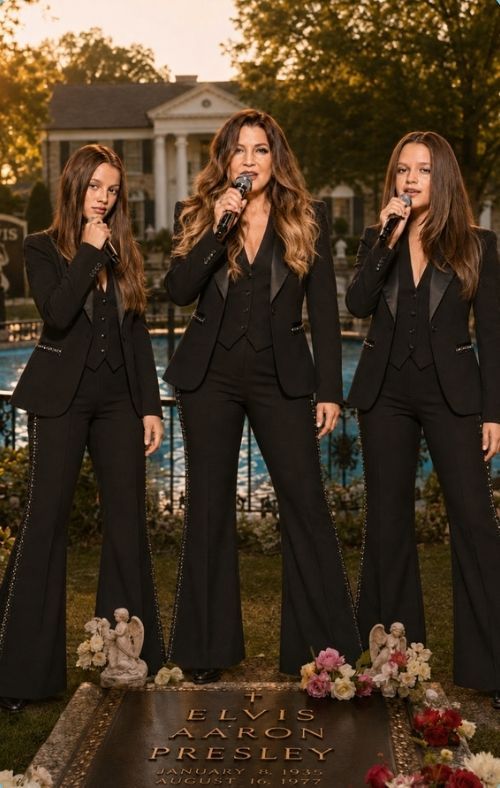
The Voice That Outlived the Legend: How One Gentle Ballad Became the Presley Family’s Eternal Heritage
Long before Graceland became a place of pilgrimage, before the white jumpsuits, the roaring arenas, and the sorrow that would eventually surround the Presley name, Elvis Presley recorded a song of remarkable simplicity. It arrived in 1961 as part of the Blue Hawaii soundtrack, yet “Can’t Help Falling in Love” would ultimately become something far greater than a piece of movie music. It became one of the defining recordings of Elvis’s career and, over time, something even more intimate: a musical inheritance carried by the generations who came after him.
What makes the recording so enduring is precisely what it does not attempt to do. Elvis does not attack the song with the explosive energy of his early rock-and-roll triumphs. There is no need for spectacle. Instead, his voice enters with extraordinary restraint, almost as though he understands that some emotions become stronger when they are spoken quietly. The melody, adapted from the centuries-old French tune “Plaisir d’amour,” moves with a stately calm, allowing every phrase to settle naturally. Elvis sounds less like the rebellious young performer who had transformed popular music and more like a man standing alone with a thought he cannot escape.
That difference matters.
By 1961, Elvis was already an international phenomenon. Millions knew the hairstyle, the movies, the records, and the unmistakable voice. Yet “Can’t Help Falling in Love” stripped away much of that machinery. Beneath the fame was a singer capable of remarkable tenderness and control. Older listeners who followed Elvis from the beginning often understand this distinction immediately. His greatness was never based solely on excitement. He possessed the rarer ability to make a large audience feel as though he were singing to one person.
Decades later, that intimacy would take on an entirely different meaning.
After Elvis died in 1977, his recordings became more than entertainment. They became a way for his family—and for millions of admirers—to encounter a man who could no longer speak for himself. For Lisa Marie Presley, her father’s voice existed not merely as an artifact of popular culture but as part of her own family history. For later generations, including Riley Keough, Harper Lockwood, and Finley Lockwood, Elvis belonged simultaneously to private memory and public mythology. Some knew him directly; others inherited him through stories, photographs, home movies, Graceland rooms, and, above all, recordings.
That is why the survival of a song can sometimes feel more powerful than the survival of an image.
Photographs freeze a person in a single instant. A recording gives them breath again.
When Elvis begins singing “Can’t Help Falling in Love,” the distance between 1961 and the present seems momentarily smaller. The listener does not merely remember Elvis Presley; the listener hears him existing in real time. His phrasing remains suspended exactly as it was when the microphone captured it more than six decades ago. Generations change, fashions disappear, and even the meaning of celebrity evolves, but the voice remains astonishingly present.
The song also gained additional significance because Elvis eventually used it as a closing number in many of his concerts. That transformed the gentle movie ballad into something resembling a farewell ritual. Night after night, the final notes announced that the performance was ending. Audiences understood what was coming, yet they waited for it anyway. In retrospect, that tradition lends the recording an almost haunting resonance. A song originally introduced during the bright optimism of the early 1960s gradually became associated with departure, memory, and the difficult act of saying goodbye.
This is where the Presley family’s eternal heritage becomes more than a dramatic phrase.
Elvis left behind estates, photographs, costumes, awards, films, and objects that can be catalogued and preserved. But his most important inheritance cannot be locked inside a display case. It is the voice. A voice can travel where possessions cannot. It can reach descendants who were not yet born. It can move through headphones, old vinyl records, family gatherings, memorial celebrations, and quiet evenings when someone simply wants to hear him again.
And perhaps that is the deeper reason this particular ballad continues to matter.
Elvis Presley spent much of his life surrounded by noise: applause, cameras, expectations, schedules, headlines, and crowds calling his name. Yet one of the recordings that survived him most beautifully is built upon stillness. One gentle melody proved stronger than the machinery of fame. It did not need fireworks to endure.
More than sixty years after Elvis recorded it, “Can’t Help Falling in Love” remains almost impossibly familiar without becoming ordinary. Every new generation discovers the song for itself, while those who remember Elvis during his lifetime hear something deeper inside it: youth, distance, loss, gratitude, and the strange persistence of memory.
The King eventually left the stage.
His family endured triumphs and devastating farewells of their own.
Graceland became both a home preserved in time and a monument visited by the world.
But the voice kept traveling.
And perhaps this is Elvis Presley’s most remarkable final achievement: the legend became history, while the song remained alive.