Introduction
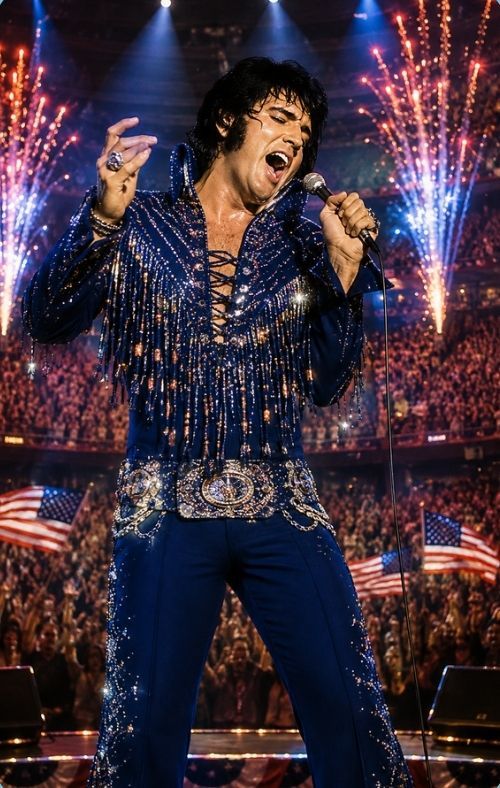
June 1972. Manhattan was ready to judge a King. The music world had changed, younger stars had risen, and some quietly wondered whether Elvis Presley’s greatest days belonged to another era. Then the lights fell inside Madison Square Garden. A roar swept through the arena. Elvis appeared—and within moments, doubt began to disappear. This was no sentimental return and no comfortable celebration of yesterday. It was a confrontation between a legend and the city that demanded proof. One stage. Thousands of witnesses. Four historic performances. And by the time New York finally went silent, the question was no longer whether Elvis still mattered—but how anyone had ever doubted him.
There are concerts that entertain, concerts that impress, and then there are rare evenings that seem to settle an argument. Elvis Presley’s appearances at Madison Square Garden in June 1972 belonged unmistakably to that final category. By then, Elvis was no longer simply the young revolutionary who had startled American television audiences in the 1950s. He had become something more complicated: an institution, a symbol, and a performer carrying nearly two decades of expectations every time he walked beneath a spotlight.
New York was therefore an especially demanding stage. The city had witnessed nearly every musical movement imaginable. Rock had evolved. Soul had deepened. Singer-songwriters were reshaping popular taste, while a younger generation was producing its own heroes. In such an atmosphere, reputation alone could not guarantee admiration. Madison Square Garden demanded presence, and Elvis arrived prepared to offer exactly that.
The remarkable quality of these performances was not simply their scale. It was the sense of command that surrounded them. When Elvis entered the arena in one of his now-famous stage suits, backed by his musicians and singers, he appeared not as a man trying to recreate the excitement of his youth, but as an experienced performer who understood exactly how to control a vast room. The audience response was immediate, yet the music itself carried the evening.
Songs such as “That’s All Right,” “Love Me,” “All Shook Up,” “Heartbreak Hotel,” “Hound Dog,” “Suspicious Minds,” and “Can’t Help Falling in Love” connected different chapters of his career. Older numbers reminded listeners where the journey had begun, while the stronger dramatic arrangements of his later concert years revealed how much his stagecraft had changed. These were not museum pieces preserved behind glass. Elvis approached them with the urgency of a performer determined to make familiar songs feel immediate again.
That distinction matters. Nostalgia can produce affection, but it cannot by itself create electricity. At Madison Square Garden, Elvis was not asking New York to remember him. He was asking New York to experience him.
The performances also demonstrated one of his most underestimated strengths: his ability to move between musical worlds without making the transitions feel artificial. Rock and roll could be followed by gospel-influenced passages, tender ballads, blues colors, and dramatic pop arrangements. His voice could shift from playful warmth to commanding force within a single program. For listeners who knew Elvis only from photographs, headlines, or memories of the 1950s, the concerts offered a reminder that his greatest instrument had always been his ability to interpret a song.

There was also something symbolic about Elvis standing in the center of Manhattan. New York represented modernity, skepticism, ambition, and relentless reinvention. Elvis represented an earlier cultural earthquake that had already transformed American popular music. When those two forces met, the result was not a battle between past and present. Instead, the concerts suggested that truly influential music does not disappear simply because fashions change.
The audience understood this almost instinctively. The applause, cheers, and emotional reactions were not merely expressions of celebrity devotion. They reflected recognition. People were watching a performer who had helped reshape popular culture prove that he could still dominate one of the most important stages in the world.
That is why the Madison Square Garden concerts remain so compelling decades later. They capture Elvis at a fascinating point between triumph and vulnerability, history and immediacy. He carried an enormous legacy onto that stage, but for those few nights he did not seem burdened by it. He used it.
Four performances. A legendary arena. A city famous for being difficult to impress.
And at the center stood Elvis Presley, facing perhaps the simplest and harshest question any famous performer eventually encounters: Can you still do it?
New York received its answer before the final curtain.
The King had not arrived merely to revisit history.
He had arrived to remind everyone that he was still capable of making it.