Introduction
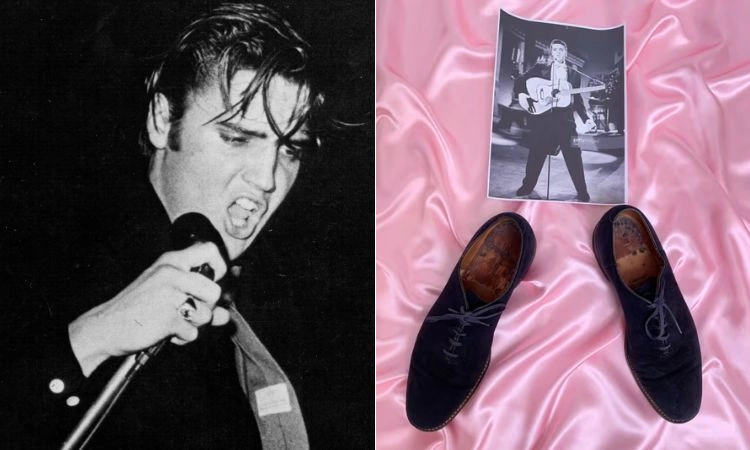
For decades, the closing chapter of Elvis Presley’s life has often been described through photographs, headlines, and stories of physical decline. Those images have sometimes created the impression that the legendary singer who transformed popular music had somehow lost the extraordinary instrument that first captivated America in the 1950s. Yet anyone willing to return to Elvis Presley’s final concert on June 26, 1977, encounters a far more complicated—and considerably more moving—story. His appearance revealed the unmistakable strain of difficult years, but once the music began, something remarkable happened. His body was clearly exhausted, yet his voice had not lost its soul.
That final concert, held at Market Square Arena in Indianapolis, now carries a historical weight that nobody inside the building could fully have understood that evening. The audience believed they were attending another Elvis Presley performance. They could not know that less than two months later, on August 16, 1977, the world would awaken to the news that one of the most influential entertainers of the twentieth century was gone. Knowing what followed makes every gesture, every smile, and every song from that evening feel different today.
What remains especially striking is that Elvis continued to rely upon the unmistakable character of his own voice. During the concert, he moved through a long program of familiar favorites, emotional ballads, gospel-influenced numbers, and songs that demanded considerable vocal strength. There was vulnerability in those performances, certainly, but vulnerability should never be confused with the disappearance of talent. His voice had changed with time, but it had never lost its emotional power.
Perhaps no moment demonstrates this more dramatically than “Hurt.” The song had already become one of the great showcases of Elvis’s later-period voice, demanding control, range, and tremendous emotional commitment. By 1977, the performance carried an additional meaning. The man singing those words was visibly struggling with his health, and the audience could sense that every great vocal climb required effort. Yet Elvis did not retreat from the challenge. He leaned into it.
That is what makes the surviving performances so affecting.
There are technically perfect performances that impress the listener for a few minutes, and then there are performances that stay in the memory because the person behind the microphone appears to be giving something deeply personal. When Elvis sang “Hurt,” the audience witnessed more than a performance. They witnessed an artist drawing upon decades of experience and reaching for the emotional center of a song even when physical strength could no longer be taken for granted.
This distinction matters when discussing Elvis’s final months. It would be easy to judge those concerts only against the astonishing young performer of 1956 or the commanding figure of the 1968 television comeback. But artists are not frozen in time. Voices mature. Bodies change. Circumstances become more difficult. The true question is not whether Elvis sounded exactly as he had twenty years earlier. Of course he did not. The more meaningful question is whether the essential quality that made people believe him when he sang was still present.
The answer can be heard in those final recordings.

Every note still carried that unmistakable Elvis identity—the mixture of gospel feeling, country warmth, blues phrasing, and dramatic instinct that no imitation could quite reproduce. At his strongest moments, the years seemed momentarily to disappear. The familiar resonance returned, the great phrases opened up, and the audience could hear why millions of people had followed this singer through changing musical fashions for more than two decades.
There was also something profoundly loyal about his determination to remain onstage. Elvis understood that audiences had traveled considerable distances and spent their money for the opportunity to see him. Performing had become increasingly demanding, but the bond between singer and listener remained central to his life. He kept singing through one of the hardest chapters of his life because music remained his most powerful connection with the world.
That relationship explains why his final concert should not be remembered merely as a sad historical document. There is sadness in watching it today because we know what was coming. But there is dignity there as well. Elvis Presley was still doing the work that had defined his life: walking onto a stage, standing before an audience, and attempting to turn a collection of songs into a shared emotional experience.
The imperfections make the evening more human, not less important.
Greatness, after all, is not always revealed when everything is easy. Sometimes it becomes clearest when circumstances are difficult and a person continues anyway. Elvis Presley did not simply carry his gift into the final months of his life—he carried it through them. His physical condition may have limited what he could do, but it could not erase the instinct, musical intelligence, and emotional communication that had made him extraordinary.
Nearly half a century later, people still return to that June evening because the footage challenges one of the simplest myths about Elvis Presley’s decline. The young revolutionary of the 1950s was gone, and the polished comeback figure of 1968 had changed, but the artist inside remained recognizable.
Listen carefully to those final songs and the truth becomes difficult to ignore.

Even when his body could no longer keep pace with the legend surrounding him, his heart never stopped singing.
That may be one of the most important reasons the world still remembers him not simply as a famous performer from another era, but as the King of Rock and Roll. His final concert was not the sound of a great voice disappearing. It was the sound of a great artist carrying that voice as far as he possibly could—and giving the audience everything he still had.