Introduction
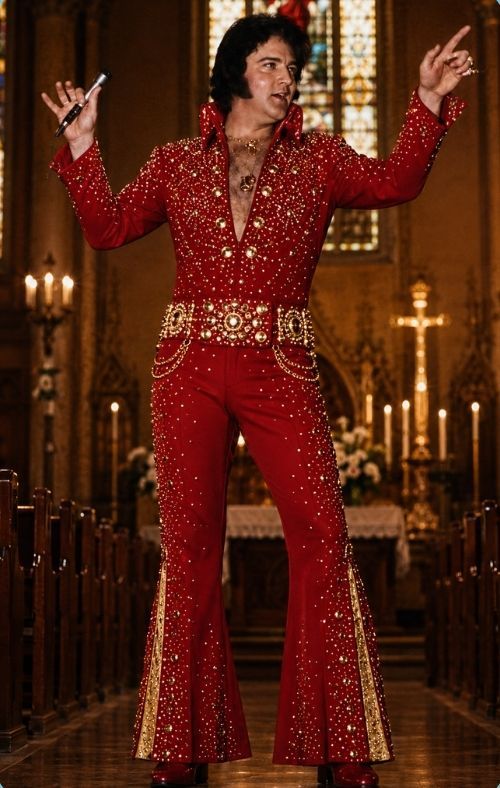
For nearly half a century, the final hours of Elvis Presley have been reduced too often to a single location, a single shocking discovery, and a collection of grim details repeated until they became more familiar than the man himself. Yet the deeper tragedy of August 16, 1977, cannot be understood through sensationalism. What can be said with more confidence is that his cardiovascular health was poor and that extensive use of prescription drugs created additional danger. Those realities deserve attention not because they make the story more dramatic, but because they reveal how complicated the final chapter of one of popular music’s most extraordinary lives had become.
Elvis was only 42. That fact remains startling. By then, however, his body had endured years of demanding performances, irregular schedules, physical strain, emotional pressure, serious health problems, and troubling patterns involving prescription medication. Any thoughtful examination of his death must therefore resist two temptations. One is to turn his final moments into a grotesque anecdote. The other is to soften the story so completely that the warning signs disappear.
That distinction is important because Elvis deserves better than either extreme version of his death. He was neither a caricature nor a flawless victim of circumstance. He was an enormously gifted human being living inside circumstances that had become increasingly difficult to control.
It shouldn’t be turned into the punchline of a bathroom story, but neither should his addiction to prescription drugs be erased by simply portraying him as a burned-out artist taking harmless medications. The truth is more uncomfortable, but also more humane. Elvis had real medical problems, and his use of prescribed drugs had become dangerous. Recognizing both realities does not diminish his achievements. If anything, it allows us to see him with greater clarity.
His final condition stemmed from a serious illness, unhealthy patterns of prescription drug use, and a lifestyle that had become increasingly difficult to sustain. Compassion doesn’t require rewriting the uncomfortable parts of his story. Compassion means acknowledging that a man can be admired for his talent while his struggles are examined without ridicule.
And perhaps that is why the most haunting part of August 16 is not where Elvis was found, but what he apparently expected to happen afterward.
So, when you remember August 16th, perhaps the bathroom should be the least interesting detail. Think instead of the unfinished plans outside that door. Elvis was preparing to leave Memphis for another series of concerts. The machinery of touring was already in motion. Musicians had obligations. Crews had schedules. Fans had purchased tickets. Somewhere beyond Graceland, arenas were preparing for the arrival of a performer who had spent more than two decades walking toward microphones under impossible expectations.
Elvis was expected to leave Memphis that evening for another tour. The clothes would be packed, the musicians would be waiting and the audience already had tickets. Nothing about the ordinary preparations suggested that history was about to divide his life permanently into a before and an after.
That is what gives the story its extraordinary emotional weight.
He entered that room expecting to go back out and continue his day. This is the true sadness of his final hours: Elvis Presley didn’t consciously walk toward an ending. There was no ceremonial farewell, no final curtain carefully arranged for posterity. There was simply another day that was supposed to continue.
At just 42, he still believed there would be another departure from Graceland, another city, another microphone, and another night to sing.
For millions who still listen to Elvis today, that unfinished expectation may be more moving than any sensational account of his death. Behind the jumpsuits, gold records, crowds, headlines, and mythology stood a man who apparently still believed there was more work ahead.
Another road.
Another audience.
Another song.
There wasn’t.