Introduction
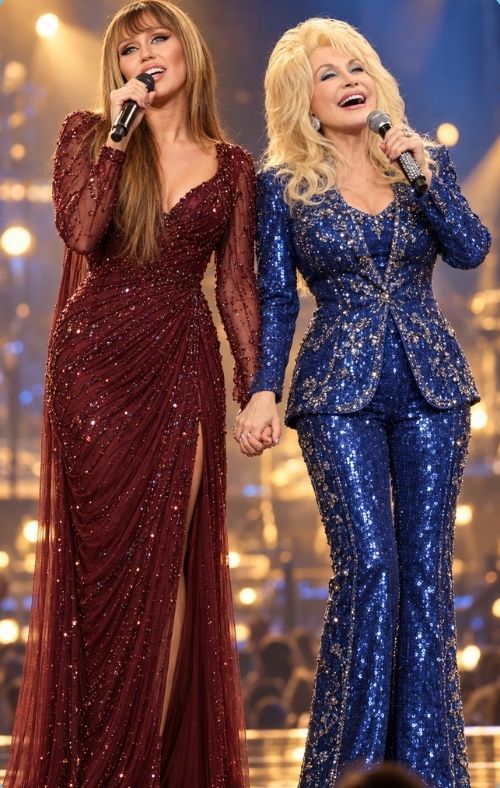
Did you know “Jolene” and “I Will Always Love You” were written on the same day? It sounds almost too remarkable to be true. Yet according to Dolly Parton, these two enduring compositions—songs with completely different emotional landscapes—were created during the same celebrated period of inspiration in 1973. One trembles with fear, jealousy, and vulnerability; the other offers gratitude, dignity, and a graceful farewell. Together, they demonstrate the extraordinary range of a songwriter who could transform complicated human emotions into language that sounded simple, direct, and unforgettable.
The inspiration behind “Jolene” came from two separate encounters. The memorable name belonged to a young admirer whom Dolly met after a performance. Dolly was struck by the girl’s beauty, particularly her red hair and green eyes, and repeated the name until its rhythm began to suggest a melody. The emotional tension of the song, however, was connected to a bank employee whose friendliness toward Dolly’s husband, Carl Dean, became a source of playful—but genuine—unease.
Rather than writing an angry confrontation, Dolly made an inspired artistic choice. The narrator does not threaten Jolene or condemn her. She openly acknowledges the other woman’s beauty and admits her own fear of losing the man she loves. That vulnerability gives the song its lasting power. Listeners do not merely hear jealousy; they hear a person setting pride aside and asking for mercy.
:max_bytes(150000):strip_icc():focal(994x0:996x2)/dolly-parton-portraits-PEOPLE-4-87f98cdf39964f4dbd06efcdd933369a.jpg)
“I Will Always Love You” arose from an entirely different turning point. Dolly wrote it as a farewell to Porter Wagoner, her longtime musical partner and television mentor, when she decided to pursue an independent career. Their professional separation was difficult, but Dolly did not want bitterness to define their final chapter. She expressed her decision through a song that carried affection without surrendering her freedom.
That distinction is essential. “I Will Always Love You” is not simply a romantic ballad. At its heart, it is a mature statement about leaving someone while continuing to value what they brought into your life. Dolly’s original recording is quiet and restrained, allowing every line to feel personal. Nearly two decades later, Whitney Houston transformed the composition into a monumental vocal performance, introducing it to another generation and demonstrating the strength of Dolly’s writing.
The contrast between these songs is astonishing. “Jolene” begs someone not to take love away; “I Will Always Love You” accepts that departure may be necessary. One is driven by anxiety, while the other is shaped by acceptance. One holds tightly; the other lets go. Yet both depend on the same quality: emotional honesty.
The story of their creation also reveals why Dolly Parton remains such an admired songwriter. She did not hide behind complicated language. She understood that a plain sentence, placed beside the right melody, could carry a lifetime of feeling. Her lyrics welcomed ordinary listeners while still rewarding careful attention.
It is the ultimate “did you know” in music history. In 1973, Dolly Parton wrote two of the most iconic songs of all time in a single sitting. Whether heard in Dolly’s intimate country arrangements or through the countless interpretations that followed, these compositions continue to cross generations, genres, and national borders.
More than fifty years later, the achievement still feels almost unbelievable: during one legendary burst of creativity, Dolly Parton gave music two opposite sides of love—our desperate fear of losing it and our courageous willingness to let it go. That is not merely an impressive chapter in country music history. It is one of popular songwriting’s greatest miracles.