Introduction
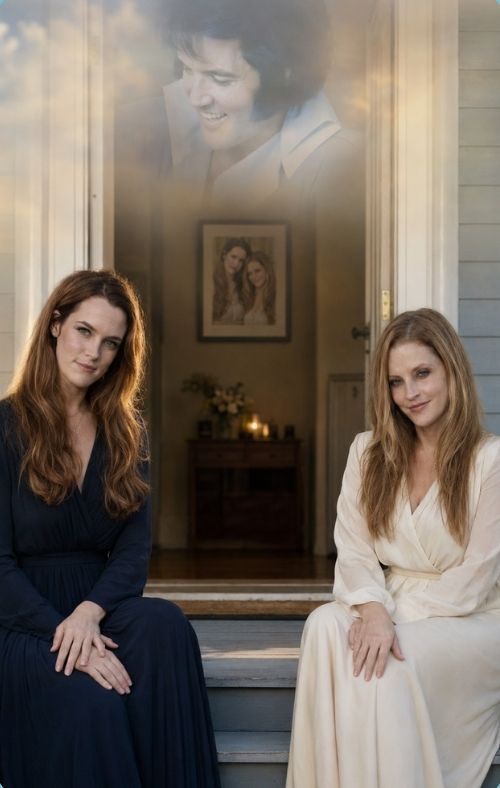
Some stories surrounding the Presley family have always seemed larger than ordinary life. There was the astonishing rise of Elvis Presley, the private world behind the gates of Graceland, and the complicated journey of his only daughter, Lisa Marie Presley. But today, it is Lisa Marie’s daughter Riley Keough who is speaking about something far quieter and more personal — moments she cannot fully explain, but which have left her feeling that the bond between a mother and daughter may continue in unexpected ways even after death.
Shocking Spiritual Update: Grieving Riley Keough says she’s been noticing “unusual signs” she believes are messages from her late mother, Lisa Marie Presley, leaving Elvis fans deeply moved. Behind that dramatic description is actually a surprisingly gentle story about grief, memory, faith, and the human desire to remain connected to those we have loved.
While discussing the experience of completing Lisa Marie Presley’s memoir, From Here to the Great Unknown, Riley revealed that she has experienced moments that seem to carry the presence of her mother. She explained that when someone is open to such possibilities, signs can seem to appear “everywhere,” adding that certain experiences have felt “too weird to not be something.” Riley did not attempt to present those experiences as scientific proof or demand that others interpret them the same way. Instead, she spoke about them as intensely personal moments that have brought a sense of connection to someone she still deeply misses.
That distinction makes Riley’s words especially moving. She is not describing a grand supernatural spectacle. There is no theatrical declaration, no attempt to turn grief into entertainment. Her reflections instead belong to something many families understand: after losing someone important, ordinary moments can suddenly feel extraordinary. A familiar song may arrive at precisely the right time. A memory may return with surprising clarity. An object, place, phrase, or coincidence can briefly make the distance between yesterday and today seem smaller.
For Riley Keough, that emotional connection carries unusual weight because she was entrusted with one of her mother’s final unfinished projects. Lisa Marie had recorded hours of memories before her death in January 2023, and Riley later used those recordings to complete the memoir. Listening again to her mother’s voice was not simply literary research. It meant returning repeatedly to a relationship that had suddenly become memory. The resulting book, published in 2024, allowed Lisa Marie’s own recollections to exist alongside Riley’s perspective as her daughter.
There is also something remarkably appropriate about this spiritual dimension appearing in the Presley story. Lisa Marie herself was interested in questions of connection beyond death. Riley has noted that the book Signs, about communicating with departed loved ones, was one of her mother’s favorites and was frequently kept in her home. Riley has also written about Elvis searching through spiritual and philosophical books in an attempt to understand larger questions about existence.
Seen through that history, Riley’s experiences feel less like an isolated curiosity and more like another chapter in a family that has spent generations trying to make sense of love, fame, loss, and what remains when someone is gone.
For longtime Elvis Presley fans, the story naturally reaches even further backward. Lisa Marie was only nine when Elvis died in August 1977. Riley has recalled that her mother believed something was wrong with her father even before his death, remembering the anxiety Lisa Marie carried as a child while watching Elvis struggle physically. Decades later, Lisa Marie would become the mother whose absence Riley herself must now learn to carry.
That generational echo is difficult to overlook: Elvis Presley, Lisa Marie Presley, and Riley Keough — three lives connected not simply by fame or Graceland, but by memory passed from parent to child.
Perhaps that is why Riley’s recent reflections have resonated so deeply. The story is ultimately not about proving whether a mysterious moment came from somewhere beyond our understanding. It is about the extraordinary persistence of love after loss.
For Riley, the smallest unexplained moment may offer reassurance that the woman whose voice she heard again and again while finishing that final book has not disappeared completely from her emotional world.
And for generations of Presley admirers, that thought carries a special tenderness. Lisa Marie Presley may be gone, but her voice remains — in her music, in her words, in Graceland, in the daughter who completed her story, and perhaps, Riley believes, in those quiet moments that are simply too unusual to dismiss.
Sometimes a legacy is carried by records, photographs, houses, and history.
And sometimes, it may be carried by something much smaller: a feeling, a coincidence, a familiar presence — and a daughter who still knows her mother well enough to recognize when something somehow feels like her.