Introduction
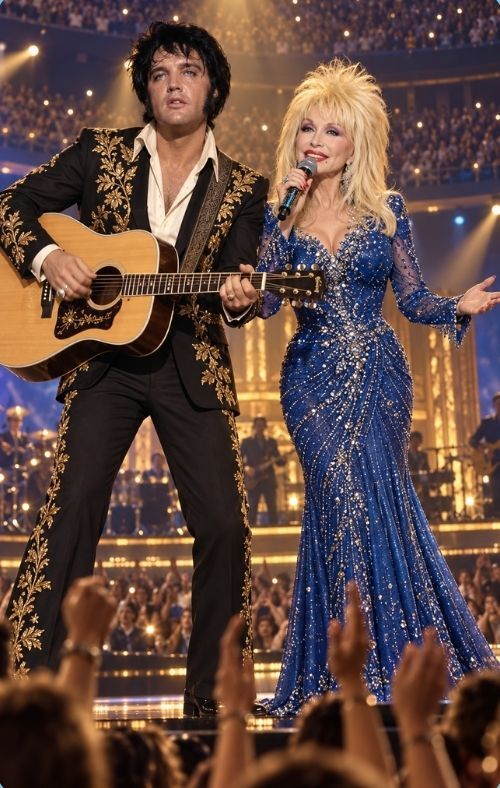
In the early 1970s, receiving a request from Elvis Presley could feel like receiving a summons from musical royalty. He was already one of the most famous entertainers in the world, and having him record one of your compositions could transform a songwriter’s career overnight. When Dolly Parton learned that Elvis wanted to sing “I Will Always Love You,” she was understandably overwhelmed. For a young country songwriter who had grown up in the mountains of East Tennessee, the possibility seemed almost too wonderful to believe.
Yet the recording never happened.
For years, the story has often been shortened into one dramatic sentence: Dolly Parton refused Elvis Presley. But that description misses the heart of what actually took place. Dolly did not reject Elvis, his voice, or his interpretation of the song. By her own account, she desperately wanted to hear him sing it. The obstacle appeared when Elvis’s manager, Colonel Tom Parker, presented a condition connected to the song’s publishing rights.
According to Dolly’s recollections, Parker’s business practice required songwriters to surrender a substantial share of the publishing when Elvis recorded their material. In the case of “I Will Always Love You,” Dolly was asked to give up half of those rights. She understood immediately what that could mean—not merely for one recording, but for the lifetime of the composition.
Her answer was no.

It was not an easy or triumphant refusal. Dolly later remembered crying over the lost opportunity. She could already imagine Elvis bringing his unmistakable voice to the song, perhaps turning its quiet farewell into one of his grand, emotional performances. Saying no meant walking away from a dream that most writers would have accepted without hesitation. Nevertheless, she recognized that the song was more than a possible Elvis recording. It was part of her creative identity and one of the most valuable things she owned. Dolly has said she was heartbroken but could not surrender the publishing.
That distinction matters. Dolly did not say no to Elvis; she said no to losing control of her work.
The decision revealed a quality that audiences sometimes overlooked beneath her warmth, humor, and mountain-born charm. Dolly was not only a gifted singer and songwriter. She was also a remarkably disciplined businesswoman who understood that songs could outlive recordings, contracts, trends, and even the people who first performed them.
Her judgment was eventually vindicated on a scale almost nobody could have predicted. Nearly two decades later, Whitney Houston recorded “I Will Always Love You” for The Bodyguard. Released in 1992, Houston’s interpretation became a worldwide phenomenon, reaching the top of the charts across dozens of countries and introducing Dolly’s composition to an entirely new generation. Because Dolly had protected her publishing, she remained the songwriter and benefited enormously from the recording’s unprecedented success. Houston’s version topped charts in 34 countries.

But the song’s true value cannot be measured by royalties alone. Dolly’s refusal became an enduring lesson about artistic ownership. At a time when performers—especially young songwriters—could be pressured into surrendering valuable rights for the promise of immediate exposure, she chose patience over prestige. She trusted the song even when doing so cost her the chance to work with the King of Rock and Roll.
One can still wonder what Elvis’s recording might have sounded like. Dolly herself reportedly imagined his voice singing it, and the performance that never happened remains one of music history’s most fascinating unanswered questions. Yet the absence of that recording also preserves the deeper meaning of the story.
“I Will Always Love You” began as a personal farewell, but Dolly’s decision transformed it into a declaration of independence. She proved that respecting a legend did not require surrendering to his business representatives. She could admire Elvis, mourn the lost opportunity, and still protect what she had created.
What she refused to give away was not simply a percentage on a contract. It was ownership of her own voice, her own future, and a song that would ultimately become one of the most recognized compositions in modern music. Elvis might have made it unforgettable for one generation. By keeping it, Dolly Parton ensured that it could belong to generations yet to come.