Introduction
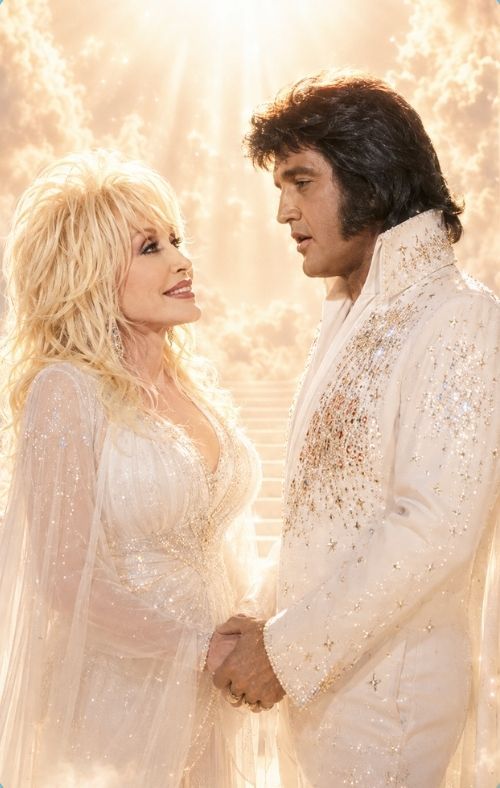
The Night Dolly Parton Said No to Elvis Presley — And Protected the Song That Would Change Her Life Forever
Few stories in country music reveal more about courage, ownership, and artistic instinct than Dolly Parton on Turning Down Elvis Presley. On the surface, the story sounds almost unbelievable. Elvis Presley—the most famous entertainer in America—wanted to record Dolly Parton’s deeply personal composition, “I Will Always Love You.” For a young songwriter still establishing her independence in Nashville, having Elvis sing one of her songs could have seemed like the opportunity of a lifetime. Yet Dolly Parton made a decision that was both painful and remarkably farsighted: she said no.
“I Will Always Love You” was written in 1973 during an important turning point in Parton’s career. She had spent years appearing alongside Porter Wagoner, whose television program and touring operation had helped introduce her to a national country audience. But Dolly was ready to step forward on her own. Rather than writing an angry farewell, she created something much more graceful. The song expressed gratitude, affection, sadness, and acceptance—the emotions that can accompany the end of an important chapter without diminishing what that chapter once meant.
That emotional restraint is one reason the song has endured. Parton does not overwhelm the listener with dramatic production or unnecessary explanation. Instead, the melody moves gently, leaving space around each phrase. Her original recording carries the unmistakable character of classic Nashville songwriting: direct language, memorable melody, and an emotional message that becomes stronger because it is expressed simply.
Then came the telephone call that almost changed the song’s history.
Elvis Presley reportedly loved “I Will Always Love You” and wanted to record it. Dolly was delighted. She admired Elvis enormously and later spoke about how excited she was by the possibility of hearing his interpretation. She could even imagine how he might sing it. For almost any songwriter of that era, an Elvis Presley recording represented extraordinary recognition.
But the arrangement came with a condition.
Elvis’s manager, Colonel Tom Parker, had a business practice that required songwriters to surrender a substantial portion of their publishing rights when Elvis recorded their material. In Dolly’s case, the request reportedly involved giving up half of the publishing rights to “I Will Always Love You.”
That was where admiration met principle.
Parton understood that songs were not simply performances. They were intellectual property, creative investments, and part of a songwriter’s long-term livelihood. She had worked too hard to build ownership of her music to surrender half of one of her most important compositions, even for Elvis Presley.
So she refused.
The decision was emotionally difficult. Dolly has recalled being deeply disappointed because she genuinely wanted Elvis to sing the song. Yet she also understood something that many young artists learn only after painful experience: a prestigious opportunity is not always a good business agreement.
That distinction is what makes Dolly Parton on Turning Down Elvis Presley such an important chapter in music history. Her refusal was not an insult to Elvis. It was an act of confidence in the value of songwriting itself.
History would eventually demonstrate just how valuable that decision became.
Dolly’s original version of “I Will Always Love You” reached No. 1 on the country chart in the 1970s. Remarkably, when she rerecorded the song for the 1982 film The Best Little Whorehouse in Texas, it returned to No. 1 again. Then, a decade later, Whitney Houston recorded a sweeping interpretation for The Bodyguard. Houston’s version became an international phenomenon and introduced Dolly Parton’s composition to an audience far beyond country music.
Because Parton had retained her publishing rights, the enormous success of later recordings belonged financially and creatively to the songwriter who had originally created the work.
Yet focusing only on money misses the larger meaning of the story.
Dolly Parton understood that ownership gives an artist freedom. By protecting “I Will Always Love You,” she preserved not merely a revenue stream but a piece of her identity. The song remained connected to the woman who wrote it at a vulnerable moment in her career, when she was leaving security behind and choosing independence.
There is also something wonderfully appropriate about the song itself becoming part of that decision. “I Will Always Love You” is, at its heart, about walking away without bitterness. Years later, Dolly faced another kind of goodbye when she declined the Elvis opportunity. She could admire him, respect his talent, and still refuse terms that were wrong for her.
For older listeners who remember an era when songwriters rarely controlled the machinery surrounding their careers, the story carries particular weight. Dolly Parton was not simply a gifted singer with an unforgettable voice and personality. She was also an unusually perceptive businesswoman who understood that creative independence required difficult choices.
Elvis Presley never recorded “I Will Always Love You.”
For Dolly, that must once have felt like a heartbreaking missed opportunity.
In retrospect, however, it became one of the defining decisions of her career—a reminder that sometimes the most important word an artist can say is not “yes,” but “no.”