Introduction
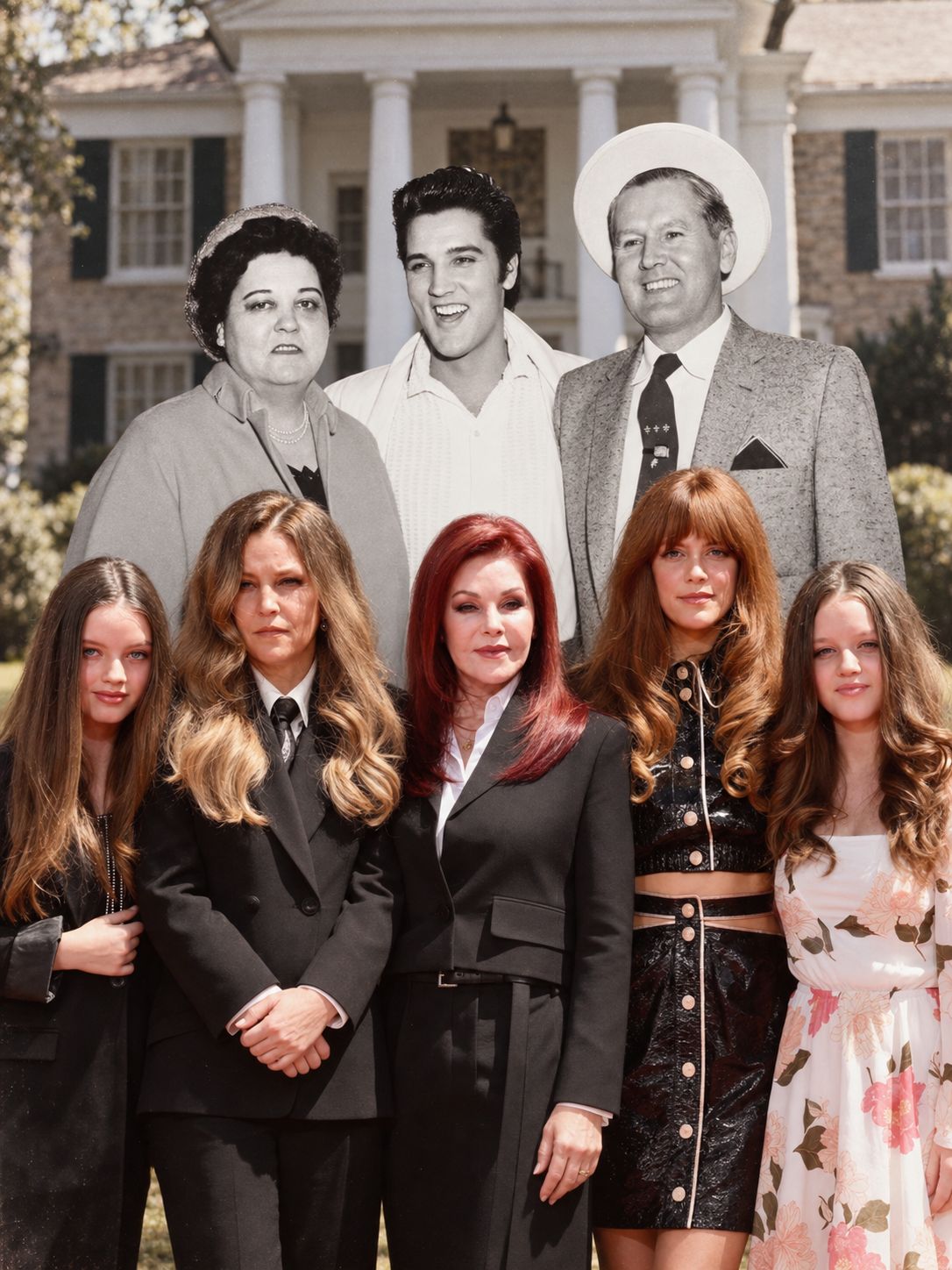
For those who grew up listening to Elvis Presley, his voice can bring back an entire chapter of life: a kitchen radio, a first record player, a familiar melody drifting through a summer evening. Yet behind that extraordinary voice stood a family whose story was far more intimate than the public legend. Before there were gold records and crowds outside Graceland, there were parents, children, modest hopes, and losses that fame could never repair.
THE PRESLEY DYNASTY WAS NEVER WHAT YOU THOUGHT — THE FAMILY TREE REVEALED… is a compelling invitation to look beyond the image of musical royalty. The real family history needs little embellishment. Its emotional force comes from understanding how closely remarkable achievement and ordinary human vulnerability can exist together.
The story begins in Tupelo, Mississippi, where Elvis Presley was born on January 8, 1935. His twin brother, Jesse Garon Presley, was stillborn. Elvis therefore grew up as an only child, although his family’s story had begun with two sons. That distinction is deeply moving without requiring us to speculate about everything Elvis may have felt throughout his life. An absence belongs to the family tree from its very first branch.
His parents, Gladys and Vernon Presley, connect the celebrated performer to the modest household from which he emerged. Gladys died in 1958, when Elvis was just 23. Remembering that early loss gives listeners a reason to approach his more reflective recordings with particular care, while resisting the temptation to treat every song as a literal account of his private life. Music offers room for feeling; it does not always provide a diary.
The next generation centered on Lisa Marie Presley, the only child of Elvis and Priscilla Presley. Born into one of the most recognizable names in entertainment, she eventually pursued a recording career of her own. Her debut album, To Whom It May Concern, arrived in 2003. For listeners willing to hear her on her own terms, her work offers an opportunity to encounter an individual voice within an enormous inherited legacy.
Lisa Marie’s family also reveals how much broader the Presley story became. She had Riley Keough and Benjamin Keough with Danny Keough, followed by twin daughters Harper and Finley Lockwood with Michael Lockwood. Benjamin died in 2020, and Lisa Marie died in January 2023. These are painful facts about a family, deserving the same compassion we would extend to people whose names never appeared in a headline.
One striking detail in this history is the presence of twins across generations: Elvis and Jesse at its beginning, and Harper and Finley among his grandchildren. It is a documented family connection, rather than evidence of a hidden mystery. Its poignancy comes from the different lives represented by those two sets of names.
There is continuity in creative work as well. Riley helped complete her mother’s memoir, From Here to the Great Unknown, allowing Lisa Marie’s recollections to reach readers after her death. Such an undertaking makes inheritance tangible: preserving a voice, listening closely, and deciding how a loved one will be remembered.
For longtime admirers of Elvis’s music, this family history offers something more lasting than a sensational revelation. It invites a gentler understanding of the people behind the photographs. Graceland may symbolize an extraordinary career, but the family connected to it reminds us why songs about home, devotion, separation, and remembrance continue to matter. We return to those songs because our own lives, too, are shaped by the people we love—and by the memories we carry forward.