Introduction
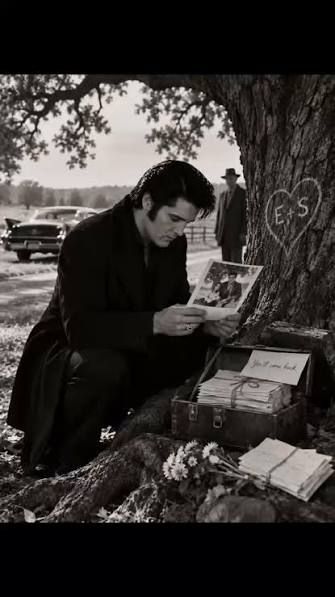
The envelope looked ordinary enough to disappear among the flowers, telegrams, and handwritten messages that followed him from one dressing room to another. There was no elaborate seal, no urgent instruction, and nothing to suggest that opening it would disturb a memory he had carried quietly for years. But in this imagined story, Elvis Presley finds something inside that applause could never prepare him for: an old photograph, a familiar face, and five words written across the back—“Why didn’t you come back?”
For a man whose voice had reached people he would never meet, the question was painfully personal. It belonged to someone who had known him before the white jumpsuits, before the television appearances, before his name became something strangers shouted across crowded streets. The girl in the photograph remembered a young man with uncertain prospects and an extraordinary love of music. Looking at her face, he could almost hear the conversation that had taken place when the picture was taken.
The mystery begins there, but its emotional power comes from something older readers will recognize: the uneasy distance between what we intended to do and what we actually did. Most people have someone they meant to visit, a letter they put aside, or a promise they assumed there would be time to keep. Years pass almost politely. Then a photograph falls from a drawer, and the unfinished business of a lifetime suddenly feels close enough to touch.
For listeners who have found comfort in Elvis’s quieter recordings, that feeling has a familiar musical shape. Beneath the excitement surrounding his performances was a voice capable of remarkable tenderness. A restrained phrase, a softened ending, or a moment of hesitation could make a song feel like a private admission. This fictional tale draws on that expressive quality, imagining the man behind the microphone confronting a question he cannot answer with a song.
His journey leads away from the demands of another performance and toward the streets of his childhood. There, an ancient oak tree still stands, its branches spreading above a place that once seemed large enough to contain every possible future. The tree becomes the story’s quiet witness. While careers rose, families changed, and familiar houses acquired new occupants, it remained rooted beside the memory of a promise.
Then come the hundreds of letters. Their importance lies in the ordinary details preserved within them: news from home, small disappointments, changing seasons, and questions written by someone who never knew whether an answer would arrive. Together, they reveal how differently two people can experience the same passing years. One life becomes crowded with departures and obligations; another keeps finding reasons to wait.
The girl herself must be more than a mysterious figure from a famous man’s past for this story to matter. She has her own years to account for, her own decisions, and her own understanding of what happened. The final letter beneath the oak tree promises to give her that voice. Whatever it reveals, it asks Elvis—and the reader—to consider whether remembering someone is enough when they once needed you to return.
That is what makes the forgotten promise such a compelling beginning. The envelope offers no explanation, only a question. To answer it, Elvis must revisit a time when his future was still uncertain and his word was something he could give without thinking about the cost. For readers who understand how swiftly a lifetime can pass, the suspense is deeply human: what will he find when he finally goes back, and what will he wish he had understood sooner?