Introduction
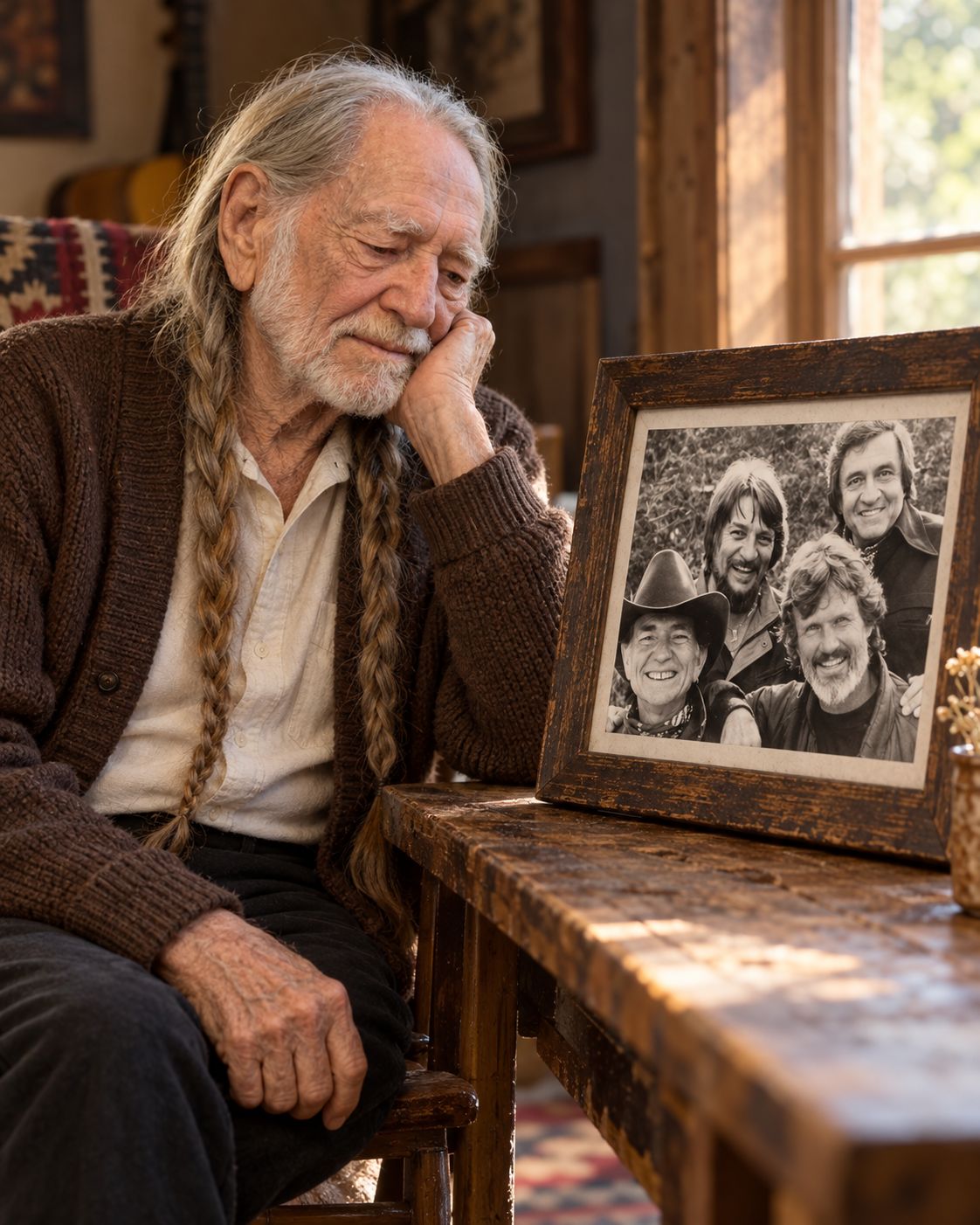
There is a particular kind of silence that comes with outliving the people who once understood you without explanation. For listeners revisiting The Highwaymen, that silence now belongs to the spaces between four unmistakable voices. Willie Nelson, Waylon Jennings, Johnny Cash, and Kris Kristofferson once stood together as a remarkable gathering of country music’s independent spirits. Today, Nelson is the group’s sole surviving member, and their recordings carry an emotional weight that even longtime admirers may find difficult to put into words.
Their first album, Highwayman, arrived in 1985, bringing four established artists into a shared musical setting. Each already possessed a voice, a history, and an audience of his own. Yet together, they created something unusually generous: a performance in which individual character strengthened the whole. Nobody needed to disappear into the background for the music to work.

That quality is especially clear in “Highwayman,” the extraordinary song written by Jimmy Webb. Its story moves through successive lives—a highwayman, a sailor, a dam builder, and a starship captain—while returning to the idea that existence continues beyond any single ending. Nelson opens the recording, followed by Kristofferson and Jennings, before Cash delivers its final, otherworldly chapter. The structure gives every singer a distinct place within one continuous journey.
Listen closely, and the differences become the song’s greatest strength. Willie Nelson’s phrasing feels conversational, as though he is recalling something over a quiet table. Kris Kristofferson brings a weathered gravity, allowing the story to emerge without decorative gestures. Waylon Jennings supplies a firm, earthy presence. Then Johnny Cash arrives with that immense, resonant voice, making the final passage feel almost larger than time itself.

For older listeners, the recording can reveal new meanings with every passing year. A song once admired for its imaginative storytelling may eventually become a meditation on the people we have lost. Its musical continuity offers a moving suggestion: a voice can finish its verse and still remain part of everything that follows.
The losses surrounding the group make that interpretation especially poignant. Jennings died in 2002, and Cash followed in 2003. Kristofferson’s death in 2024 left Nelson as the last surviving Highwayman. At 93 in 2026, Nelson represents a living connection to a partnership whose original four voices can now be reunited only through recordings and memory.
Three empty spaces beside him are a powerful way to imagine that absence. They stand for different temperaments, familiar voices, and a musical understanding built over years. The records allow us to hear that understanding directly: the ease of passing a song from one singer to another, the confidence of giving someone else the next verse, and the pleasure of belonging to something shared.
Any account promising the exact private conversations from their final tours needs reliable documentation. Their music, however, offers its own accessible evidence of connection. We can hear the attention they give one another and the room they leave for each voice. Those qualities help explain why the brotherhood still matters.
Return to “Highwayman” today, and its emotional center seems to have shifted. The adventure remains, but remembrance has moved closer to the foreground. Four men enter the song, each carrying a different story, and together they create a sense of endurance.
For those who grew up with these voices, hearing them again can feel like opening a familiar door. Willie Nelson begins the first verse, and for a few precious minutes, all four Highwaymen are there.