Introduction
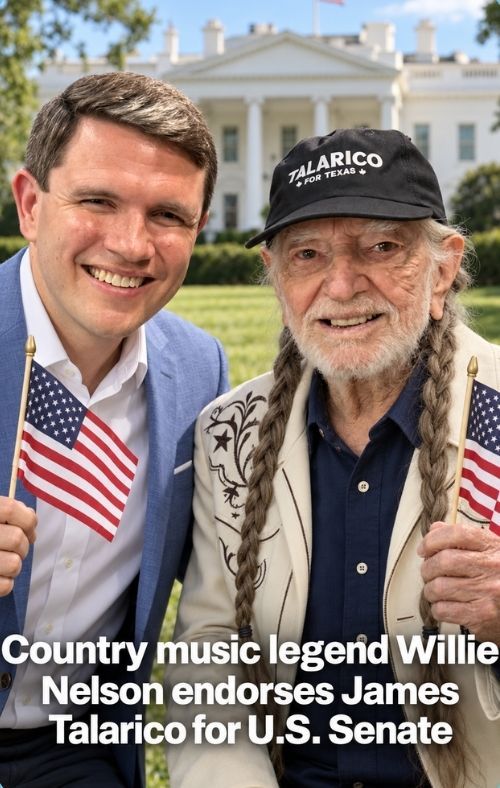
For generations, Willie Nelson has been a voice people recognize almost immediately. His unhurried phrasing, weathered warmth, and conversational delivery give his performances a distinctive intimacy. Now, that familiar voice has entered a different setting: a political endorsement. Nelson has publicly expressed his support for James Talarico for the U.S. Senate, in a video reported by the Houston Chronicle. It is a brief statement, but one that brings together two subjects often intertwined in American life—music and public affairs.
“I’ve gotten to know James Talarico. He’s a good man and will be a good senator for the state of Texas,” Nelson says. The wording presents his endorsement as a personal judgment, grounded in his acquaintance with the candidate. It communicates Nelson’s opinion of Talarico’s character and potential service; it does not, by itself, offer a detailed assessment of the candidate’s policies. That distinction helps place the announcement in its proper context.
From a music critic’s perspective, the interesting element is how a familiar artistic voice changes meaning when it moves beyond a song. In performance, Nelson’s delivery invites listeners to pay attention to small inflections rather than grand gestures. His singing often feels like a conversation already underway. An endorsement draws upon that same recognizability, although its purpose is different: the artist is speaking as a citizen and expressing a political preference.
Country music and public life have long shared a vocabulary of home, work, community, and belonging. These subjects can carry different meanings for different listeners. A song about hardship may evoke a family memory for one person and a question about public policy for another. Consequently, an artist’s political statement can prompt discussion far beyond the words actually spoken, especially when audiences have spent years forming their own relationship with the artist’s music.
That relationship deserves careful consideration. Admiring Willie Nelson’s music does not require agreement with every position he takes. Likewise, disagreement with an endorsement need not erase the significance of a recording or the pleasure of a remembered concert. Listeners can distinguish between an artist’s creative contribution and his political choices while taking both seriously.
Celebrity endorsements also have practical limits. They can draw attention to a campaign and introduce a candidate to people who might otherwise overlook the race. They cannot establish how that candidate would perform in office. Evaluating James Talarico, as with any Senate candidate, requires examining his record, proposals, and responses to public scrutiny.
For readers interested in Nelson’s place in American culture, this announcement offers a revealing moment: a widely recognized musician lending his voice to a decision outside the concert hall. The cultural interest lies in that transition—from interpreting songs to expressing a civic preference—and in how audiences respond when a familiar voice enters a contested public conversation.
Willie Nelson’s endorsement is therefore both a straightforward political statement and an opportunity to reflect on the relationship between artists and their audiences. His words tell us whom he supports. The music remains a shared experience, while the electoral judgment belongs to each voter.