Introduction
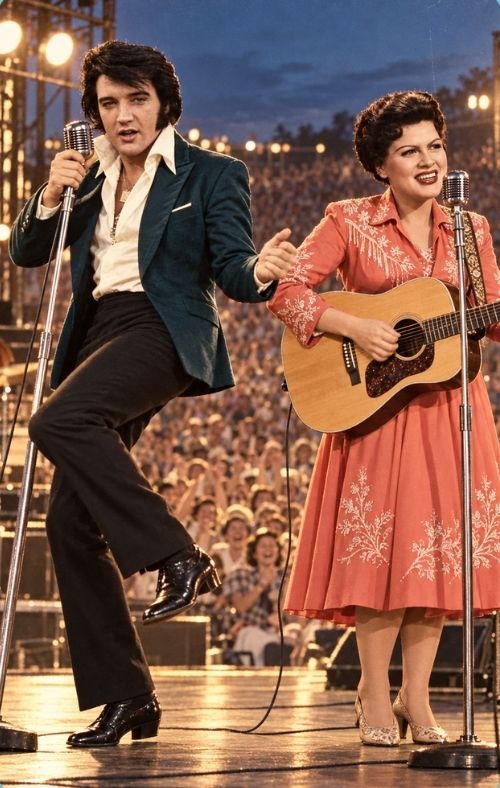
In 1956, Elvis Presley was 21 and moving through a year that would change his life. His records were reaching new audiences, television was bringing him into American living rooms, and each appearance seemed to bring a fresh argument about how he ought to perform. Somewhere within that remarkable year sits a story about a quiet backstage conversation with Patsy Cline. It is an appealing story. It is also one that deserves to be told with care.
According to the account, Elvis was feeling pressure to soften the style that made him distinctive. Cline, then still working toward her national breakthrough, approached him and offered a few encouraging words. The suggestion is that she recognized something in his voice and manner that he needed to protect. Yet the story offers no reliably documented date, venue, witness, or record of what either artist said. We cannot know from the available evidence whether this conversation happened, much less whether it changed the course of Elvis’s career.

What we can hear is why people want the story to be true. Both singers made an unusually direct connection with listeners. Elvis could turn a song into an event through the force of his phrasing and presence. Cline, whose major breakthrough came with “Walkin’ After Midnight” in 1957, would become known for a voice that could hold strength and vulnerability within the same line. Her later recordings made even familiar feelings sound deeply personal. The Country Music Hall of Fame describes the lasting influence of her singing on generations of vocalists.

Their paths also invite us to think about the demands placed on a rising performer. A singer needs an audience, but attention can quickly become a demand to explain, polish, or repeat whatever first drew that audience in. In 1956, Elvis was already appearing on national television. On July 1, The Steve Allen Show presented him in formal dress singing “Hound Dog” to a basset hound, a strikingly different setting from the performances that had stirred such excitement. By September 9, he was on The Ed Sullivan Show, singing before one of television’s largest audiences. Those appearances are documented; a connection between them and any advice from Cline is not.

Listen again to “Hound Dog” or “Don’t Be Cruel” from that period, and the lasting interest becomes clearer. Elvis’s timing has an ease that can disguise how much personality he brings to every phrase. He does not simply deliver the notes. He changes the weight of a word, leaves a little room before the next line, and makes the performance feel alive in the moment. That musical confidence is real, whether it grew through experience, encouragement from people around him, or his own instincts.
The alleged backstage encounter remains a question, not a discovered turning point. Still, it opens a worthwhile way to revisit two extraordinary American voices. Patsy Cline and Elvis Presley each showed how much a singer’s individual sound could matter. If they shared a word of encouragement in 1956, it has yet to be firmly established. Their recordings, however, give us something certain: two artists whose voices still reward close listening, long after the backstage doors closed.
Video