Introduction
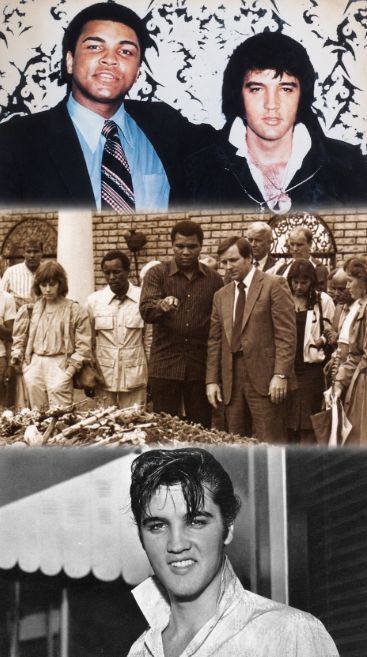
Some friendships are remembered through letters, photographs, or stories told long after the people involved are gone. Others are preserved in a single, powerful image: one legendary figure standing silently before the resting place of another. Such is the emotional weight behind the story of Elvis’ close friend, Muhammad Ali visits his grave at Graceland.
After Elvis Presley died on August 16, 1977, Graceland became more than the private home of a famous entertainer. It became a place of pilgrimage, drawing grieving admirers from across America and around the world. Ordinary families stood beside musicians, actors, politicians, and cultural figures, all united by the feeling that something irreplaceable had disappeared. Elvis had been only 42, yet his voice had already become woven into the memories of an entire generation.
Among those associated with this story was Muhammad Ali, the man celebrated worldwide as “The Greatest.” At first glance, Elvis and Ali appeared to belong to entirely different worlds. Elvis ruled concert stages with his unmistakable voice and magnetic presence, while Ali commanded boxing arenas with speed, courage, wit, and extraordinary confidence. Yet beneath their public images, the two men recognized something familiar in each other.
Both understood the loneliness that could accompany enormous fame. Both had risen from modest beginnings and become symbols far greater than their professions. They lived under constant public attention, faced controversy, and carried the expectations of millions. Their mutual admiration was therefore not simply the polite respect of one celebrity for another. It reflected a deeper recognition between two men who understood what it meant to become an American legend while still trying to remain human.
Their friendship was memorably represented in 1973, when Elvis presented Ali with a specially designed boxing robe before Ali’s fight against Joe Bugner. The white robe, decorated with rhinestones, carried the words “People’s Choice.” Ali, in return, gave Elvis a pair of boxing gloves bearing a personal message. These gifts were more than glamorous souvenirs. They reflected warmth, humor, and genuine respect between two towering personalities.
That history gives the image of Ali paying tribute at Graceland its emotional power. There was no cheering crowd to conquer and no championship to win. The famous showman’s home had become a place of remembrance, and the silence surrounding Elvis’s grave spoke more clearly than any grand speech could have done.
For Ali, saying goodbye to Elvis may also have meant confronting the fragile truth behind fame. Champions eventually leave the ring. Singers eventually step away from the microphone. Applause fades, arenas empty, and the public moves forward. What remains is character, influence, and the memories carried by those who witnessed greatness.
Elvis and Ali changed American culture in different ways, but both inspired people to imagine a larger life. Elvis transformed popular music by bringing together gospel, country, rhythm and blues, and rock ’n’ roll. Ali transformed sports by making the athlete’s voice as important as his physical performance. Neither man was merely an entertainer. Each became a symbol of possibility, defiance, and individuality.
The thought of Muhammad Ali standing at Elvis’s grave remains moving because it strips away the titles. In that solemn setting, they were no longer simply “The Greatest” and “The King.” They were two friends separated by death—one offering a final gesture of respect to the other.
Graceland has welcomed countless visitors, but this tribute carries a special meaning. It reminds us that even the most celebrated men can mourn quietly, and that behind every public legend is a private human story. When Ali came to remember Elvis, greatness bowed its head before greatness—and for one unforgettable moment, silence became the most powerful tribute of all.