Introduction
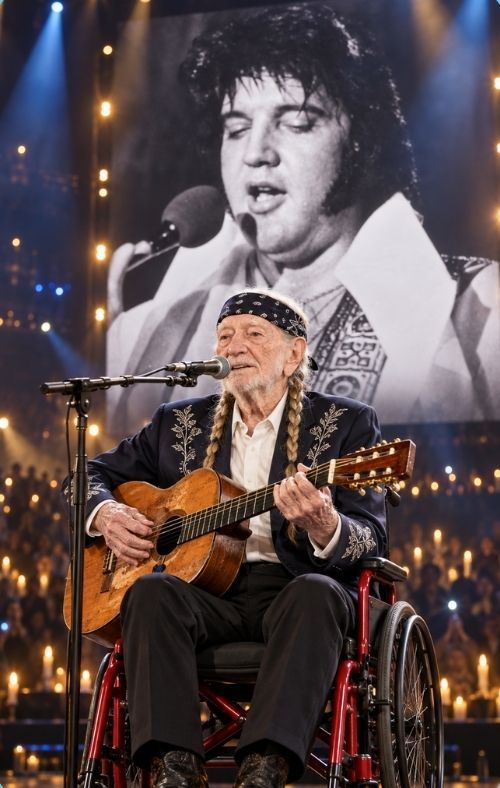
There are songs that belong to one singer, and there are songs that seem to carry the memories of everyone who has ever performed them. “Always on My Mind” belongs to the second category. When Willie Nelson performed the song to honor Elvis Presley, the familiar lyrics appeared to take on an entirely different meaning. What had long been heard as an admission of regret suddenly sounded like a conversation between two American legends—one still standing beneath the lights, the other preserved forever in music and memory.
Elvis Presley recorded “Always on My Mind” in 1972, during a difficult and deeply emotional period in his personal life. His interpretation was tender, vulnerable, and remarkably restrained. Rather than approaching the song with the dramatic power that defined many of his greatest performances, Elvis allowed its sadness to remain exposed. His voice carried the weight of a man looking backward, recognizing the things he should have said and the moments he could no longer recover. That emotional honesty helped transform the recording into one of his most enduring ballads.

A decade later, Willie Nelson offered his own unforgettable interpretation. Released in 1982, Willie’s recording brought a different kind of sorrow to the song. His voice did not soar in the way Elvis’s could; instead, it wandered gently through the melody, weathered by experience and softened by time. Every pause seemed deliberate. Every imperfect edge in his delivery made the confession feel more believable. Willie was not simply singing about regret—he sounded as though he had lived beside it for many years.
That is why hearing Willie Nelson perform “Always on My Mind” in honor of Elvis Presley carries such extraordinary emotional power. The song becomes more than a celebrated country standard. It becomes a bridge between two men who represented different traditions yet shared an instinctive understanding of loneliness, fame, loyalty, and loss. Elvis brought gospel intensity, blues feeling, and Southern grandeur to popular music. Willie brought the quiet independence of the Texas songwriter, proving that a fragile voice could sometimes reveal more truth than a flawless one.

In such a tribute, Willie does not need elaborate staging or a long speech. His unmistakable phrasing says enough. One can imagine the room becoming still as the opening notes are played and the audience recognizes the song. Older listeners remember where they were when they first heard Elvis sing it. Others recall Willie’s landmark recording and the way it seemed to speak for people who struggled to express affection before it was too late.
The most moving quality of “Always on My Mind” is its refusal to make excuses. It acknowledges failure while preserving love. In Willie’s hands, and within the shadow of Elvis’s legacy, the song sounds almost like an apology offered across the years—a recognition that even the greatest performers carried private regrets behind their public triumphs.
By the final line, the tribute no longer feels like one famous singer honoring another. It feels like Willie Nelson speaking on behalf of generations who still miss Elvis Presley. The King may have left the stage decades ago, but through this timeless song, his voice—and the emotions it awakened—remain always on our minds.