Introduction
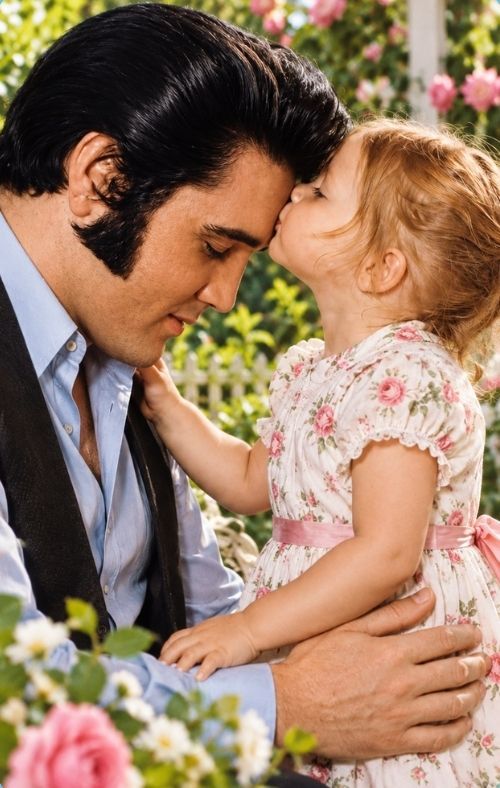
“Looking back, there was really only one thing I was sure of: I was loved by my dad.” Few reflections connected to Lisa Marie Presley carry more emotional weight than those simple words. They cut through decades of mythology surrounding Elvis Presley and reveal something far more private than the dazzling costumes, screaming audiences, gold records, and historic concerts. To millions, Elvis was “The King,” one of the most recognizable entertainers the world had ever known. To Lisa Marie, however, he occupied a role that mattered far more deeply: he was her father.
Born in 1968, Lisa Marie entered a world already transformed by her father’s extraordinary fame. By then, Elvis Presley was not simply a successful singer. He had become a cultural symbol whose face, voice, and mannerisms were recognized across generations and continents. Yet fame has a strange way of turning human beings into distant figures. Photographs become icons, homes become landmarks, and private memories become subjects of public fascination. The relationship between Elvis and Lisa Marie reminds us that behind every legend exists a private life that audiences can never completely see.
For Elvis, his daughter represented something profoundly personal. Accounts of their years together have long portrayed a father who delighted in having Lisa Marie near him and who enjoyed giving her affection, attention, and unforgettable childhood experiences. Inside Graceland, away from concert halls and television cameras, the man celebrated by millions could simply become “Daddy.” That contrast is important. The public knew the performer who commanded enormous stages, but Lisa Marie knew the man who could make her feel protected and treasured.
That certainty — “I was loved by my dad” — becomes even more moving because their time together was painfully short. In 1977, when Lisa Marie was only nine years old, Elvis died at the age of 42. Suddenly, the father whose presence had shaped her childhood became someone the entire world wanted to remember, discuss, analyze, and sometimes mythologize. For a young daughter, however, the loss was not primarily historical. It was personal. She had lost the person whose fame meant very little compared with the simple fact that he belonged to her family.
As Lisa Marie grew older, she carried a complicated inheritance. She bore one of the most famous surnames in entertainment history, lived with constant public attention, and became a guardian of memories that millions of strangers believed they somehow shared. Yet among all those expectations, the knowledge of her father’s affection remained something uniquely hers.

That may be why her reflection continues to resonate so strongly. The certainty that she mattered deeply to him was more enduring than celebrity. Fame can change. Public opinion can change. Records can be broken, and generations can reinterpret an artist’s legacy. But the memory of being genuinely loved has a permanence that statistics and headlines cannot match.
There is also something quietly revealing here about Elvis Presley’s legacy. Discussions about Elvis often focus on his groundbreaking records, extraordinary voice, television appearances, Las Vegas years, fashion, influence, and the cultural transformation surrounding his career. Those achievements deserve their place in music history. Yet Lisa Marie’s memories invite us to consider another measure of a person’s life.
Perhaps a legacy is not only what someone leaves behind for millions of admirers. Perhaps it is also what remains inside the people who knew that person most intimately.
For Lisa Marie, Elvis was not merely the man who sang to packed arenas. He was the father whose affection gave her a certainty she could carry through adulthood. And there is something deeply human about that distinction. The world remembers Elvis as a King, but Lisa Marie remembered the father who loved her.
In the end, that may be one of the most affecting ways to understand the man behind the legend. Long after the applause faded and the stage lights went dark, something quieter survived: a daughter’s conviction that she had been deeply loved by her dad.
Because ultimately, the most meaningful legacy may not be how many people remember your name.
It may be whether the people closest to you never had to wonder how much they meant to you.