Introduction
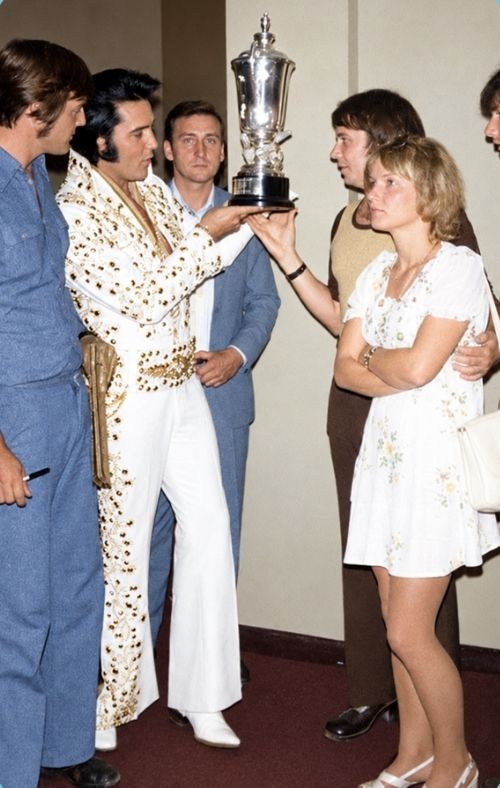
September 3, 1973: This photograph captures Elvis during the final day of his August 6 through September 3, 1973 engagement at the Las Vegas Hilton, surrounded by international fans and members of the press. At first glance, it may seem like another pleasant backstage photograph from the extraordinary career of Elvis Presley. Yet the longer one studies the scene, the more it begins to reveal. This was not simply a famous singer posing for a camera. It was a remarkable snapshot of how far Elvis’ influence had traveled by the early 1970s—and of a night that would become one of the most unusual chapters in his long relationship with Las Vegas.
Standing beside Elvis were Sten Berglind, a Swedish newspaper reporter and devoted admirer of Presley, and Todd Slaughter, president of the Official Elvis Presley Fan Club of Great Britain. Their presence tells its own story. By 1973, Elvis was no longer merely an American phenomenon whose records happened to sell overseas. He had become an international cultural figure whose admirers crossed national borders, languages, and generations. Fans who had never seen Memphis, Tennessee, or walked through the doors of Graceland still felt an extraordinary connection to the man and the music.
The large silver trophy in Elvis’ hands gives the photograph even greater historical meaning. It was connected to the New Musical Express (NME) readers’ poll, in which Elvis had been voted Top World Male Singer. Todd Slaughter had been entrusted with presenting the honor to Elvis during the Las Vegas engagement. For British listeners, the award represented something larger than another prize on a shelf. It demonstrated that years after Elvis had first transformed popular music in the 1950s, his appeal remained powerful enough to command loyalty on the other side of the Atlantic.
There is something especially fitting about Elvis receiving such recognition in Las Vegas. The city had become one of the defining stages of the second half of his career. Following his celebrated return to live performance at the end of the 1960s, his Las Vegas appearances allowed audiences to experience a performer who had evolved considerably from the young rock-and-roll sensation of earlier years. His concerts could move effortlessly between gospel, country, rhythm and blues, dramatic ballads, and the familiar hits that had helped define an era. The voice could be commanding one moment and unexpectedly tender the next.
But the date—September 3, 1973—makes this photograph particularly fascinating. It was the closing day of an engagement that had begun on August 6, 1973. Elvis was scheduled to perform both his 8:15 p.m. dinner show and the midnight closing performance. Closing nights often carried a different atmosphere. After weeks of repeating a demanding schedule, musicians and performers could feel both exhaustion and liberation. The final midnight performance would become remembered as one of the more unusual shows of Elvis’ Las Vegas years, filled with extended joking, playful interaction with the audience, and an unconventional stage entrance.
That contrast gives the backstage photograph a quiet emotional power. In front of the audience stood Elvis Presley, the superstar expected to command the room night after night. Behind the curtain was a man meeting journalists, receiving representatives of international fan clubs, posing for photographs, and accepting reminders of just how deeply his music had affected people far beyond America.
Fans, journalists and Elvis fan club representatives from around the world were continually making their way backstage to meet him. These meetings were an important but sometimes overlooked part of the Presley story. Long before social media allowed performers to speak directly to millions of followers, fan clubs created communities that kept artists connected to listeners thousands of miles away. Letters, newsletters, photographs, records, newspaper reports, and personal accounts passed from one admirer to another. Elvis’ international reputation was built not only by record sales but by people who worked tirelessly to keep his music alive within their own countries.
That is why Todd Slaughter’s presence is particularly meaningful. As one of Elvis’ most dedicated British supporters and an important figure within the worldwide fan club community, he represented countless listeners who had followed Presley’s career from afar. Standing beside Elvis with an international music award was, in a sense, a moment shared by all of them.
More than five decades later, the photograph survives as something greater than celebrity memorabilia. It captures a brief intersection between Elvis Presley, the international press, devoted fans, Las Vegas history, and the NME Top World Male Singer award. The trophy may attract the eye, but the people surrounding Elvis tell the deeper story.
They remind us that the true scale of Elvis Presley’s legacy was never measured only by the size of a theater or the number of records sold. It could also be measured in distance—in the thousands of miles people traveled, the countries where fan clubs flourished, and the generations of listeners who continued to recognize something distinctive in his voice.
On September 3, 1973, as another Las Vegas engagement approached its final curtain, one photograph quietly captured that remarkable connection. Elvis stood holding an award from readers far across the Atlantic, surrounded by people who had helped carry his name around the world. It was a simple backstage moment—but viewed through the distance of history, it has become a compelling portrait of just how global the Elvis phenomenon had become.