Introduction
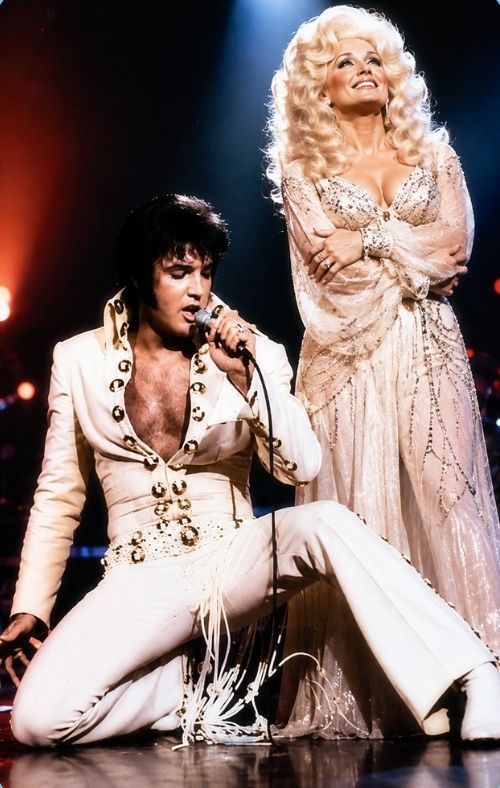
Dolly Parton Said No to Elvis Presley — The Heartbreaking Business Decision That Protected “I Will Always Love You” and Changed Her Legacy Forever
Few stories in country music reveal the difference between fame and ownership as powerfully as the moment Dolly Parton Said No to Elvis Presley — The Decision That Nearly Cost Her Everything Became Her greatest lesson in protecting the work she had created. On the surface, it sounded like the opportunity of a lifetime. Elvis Presley, already one of the most famous entertainers on earth, wanted to record Dolly Parton’s “I Will Always Love You.” For a young songwriter building her career in Nashville, having Elvis sing one of her compositions could have opened doors that most musicians could only imagine. Yet Dolly ultimately walked away.
To understand why, one must first understand what “I Will Always Love You” represented to Dolly Parton. Written in 1973 as a farewell to her professional mentor and longtime musical partner Porter Wagoner, the song was never simply another entry in a publishing catalogue. It was an unusually personal composition, built around gratitude, separation, dignity, and the painful recognition that sometimes moving forward means leaving someone important behind. Dolly recorded the song herself, and in 1974 it became a major country success.
Then came the extraordinary news: Elvis Presley wanted to record it.
Dolly later recalled being thrilled by the possibility. Her admiration for Elvis was genuine, and hearing that he wanted her song was an enormous compliment. She even imagined what his voice might bring to the composition. But before the recording could happen, there was a business condition attached to the deal. Elvis’s management, associated with Colonel Tom Parker, wanted a substantial portion of the song’s publishing rights as part of the agreement.
That changed everything.
For Dolly, publishing was not an abstract business term. It represented control over the song she had written and a share of whatever value that song might possess in the future. Giving away a significant portion simply to secure an Elvis Presley recording would have meant surrendering something she believed belonged to her as the songwriter.
And so Dolly Parton said no.
It was an astonishing decision. Many artists of that era would have accepted almost any condition for the chance to have Elvis Presley record their material. His name could transform a songwriter’s reputation overnight. Dolly understood exactly what she was refusing, and she has said that the decision was emotionally difficult. According to her later recollections, she cried because she had desperately wanted to hear Elvis sing the song.
Yet she refused to sacrifice ownership for prestige.
That decision became even more remarkable with time.
Nearly two decades later, Whitney Houston recorded “I Will Always Love You” for The Bodyguard. Her interpretation became a worldwide phenomenon, introducing Dolly’s composition to an entirely new generation and turning the song into one of the most recognizable ballads in popular music history. Because Dolly had preserved her publishing interest, she also benefited from the enormous success of that later recording.
The story is sometimes remembered simply as the day Dolly Parton turned down Elvis Presley, but that description misses the deeper lesson. Dolly did not reject Elvis. She rejected a business arrangement that required her to surrender too much of what she had created.
That distinction matters.
Behind Dolly Parton’s warm humor, sparkling stage presence, and unmistakable Tennessee voice has always been an unusually sharp understanding of songwriting as both art and property. She recognized something many young performers learn only after painful experience: applause may disappear, trends may change, and even extraordinary opportunities may pass, but ownership of meaningful work can endure for generations.
There is also something beautifully bittersweet about imagining the recording that never happened. Elvis’s rich, emotional delivery might have produced an unforgettable version of “I Will Always Love You.” Dolly herself has spoken about how much she would have loved to hear it. Music history lost one fascinating possibility that day.
But Dolly Parton preserved something even more important.
She preserved the independence of the songwriter behind the song.
Years later, when Whitney Houston’s voice carried Dolly’s words around the world, the wisdom of that painful Nashville decision became impossible to ignore. The woman who once walked away from the King of Rock and Roll had not been foolish, stubborn, or shortsighted. She had understood the long game.
Sometimes the most important moment in an artist’s career is not the opportunity they accept.
Sometimes it is the one they have the courage to refuse.