Introduction
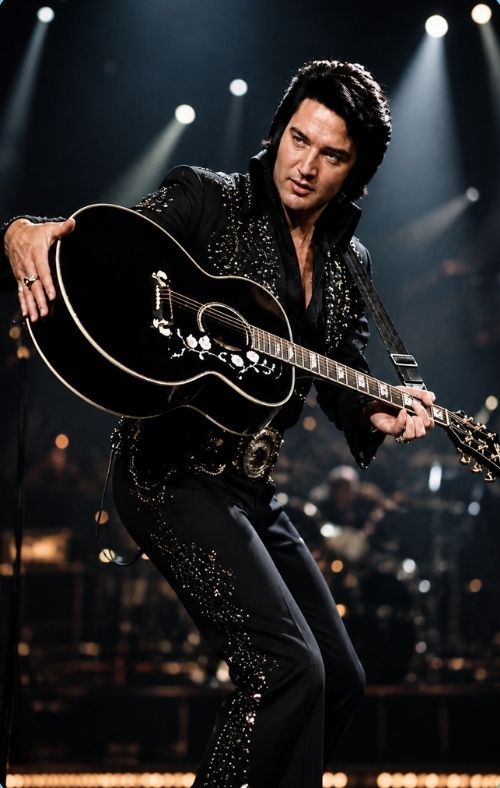
There are countless stories about Elvis Presley’s voice, his charisma, the screaming crowds, the famous costumes, and the extraordinary atmosphere that followed him from one city to another. Yet some of the most revealing glimpses of Elvis do not come from the stage at all. They come from quiet conversations when the lights were off, the audience was miles away, and the man behind the legend could speak plainly about his craft. One such conversation, remembered from a plane ride during a period of renewed touring excitement, offers a fascinating explanation for something audiences could always sense but perhaps never fully understand: Elvis Presley deliberately protected the nervousness he felt before a performance.
There was tremendous energy and excitement in Elvis’s group about being on the road, just as there had been back in 1957. But on one plane ride, when he and I were sitting together, Elvis asked me a question I hadn’t expected to hear from him. “GK, do you get nervous when you come out to do your TV show?” “Well, Elvis, I make a point not to give myself enough time to get nervous. The show goes on at five, and from the moment I get there at three, I’m running around like crazy trying to get everything organized. I don’t really think about being in front of the camera until the last couple minutes before showtime and then, yeah, I always do get nervous. As long as I’ve been doing it, I still get nervous.” “Good. That’s what I want to hear.” “What do you mean?” “If you’re going to put on any kind of a show, it’s good to have that nervous energy, otherwise you come out flat. That’s one of the reasons I don’t want to get to any of these venues early. You’ve got to meet everybody and shake hands with the president of this and that, and by the time you go onstage you’re too comfortable. You got no edge. You’ve got to let your nerves work for you.”
That final thought—“You’ve got to let your nerves work for you”—says more about Elvis as a performer than many pages of statistics ever could. Here was one of the most recognizable entertainers in the world admitting, indirectly but unmistakably, that nervousness still mattered to him. Fame had not erased uncertainty. Experience had not completely removed tension. Instead of viewing those feelings as weakness, Elvis apparently regarded them as fuel.
For older listeners who remember the excitement surrounding an Elvis concert, this explanation may help clarify why even familiar songs could feel unusually alive when he performed them. Elvis rarely approached a stage as though he were simply completing another engagement. His strongest performances carried urgency. There was often the impression that something unexpected might happen—that a song might suddenly become slower, louder, more emotional, or more playful depending on the room.
That quality cannot easily be rehearsed.
A professional entertainer can memorize arrangements, lighting cues, entrances, and introductions. But what Elvis was describing was something deeper: maintaining an emotional edge. Arriving too early, shaking too many hands, becoming accustomed to the surroundings, and settling comfortably into the building could weaken the tension he wanted to carry onto the stage. Comfort, in his view, could become the enemy of excitement.
It is an intriguing philosophy because it contradicts what many people imagine about successful performers. We tend to assume that greatness means eliminating nervousness. Elvis appears to have believed the opposite. The goal was not to destroy those nerves but to control them—to transform apprehension into momentum.
Think about the opening moments of an Elvis concert. The anticipation of the audience was enormous, but there was another force operating from the opposite side of the curtain. Elvis knew thousands of people were waiting. He understood the expectations attached to his name. Rather than pretending those expectations did not exist, he seems to have used them.
That may explain the almost electrical quality found in so many recordings of his live appearances. The band could be powerful, the arrangements carefully prepared, and the musicians highly experienced, yet there remained something spontaneous at the center of the performance. Elvis was responding to the audience while the audience responded to him.
The comparison to 1957 is especially meaningful. By the later touring years, Elvis was no longer the young newcomer fighting to establish himself. He had already experienced extraordinary fame, motion pictures, television appearances, record-breaking success, military service, major comebacks, and years of public scrutiny. Yet the touring party could still experience something resembling the excitement of those earlier days.
Perhaps that is because Elvis never entirely allowed performance to become ordinary.
There is something quietly moving about imagining him on an airplane, away from the spotlights, asking another experienced television personality whether nervousness ever disappeared. The question suggests curiosity, but perhaps also reassurance. When he heard that another seasoned professional still felt nervous before appearing before the public, Elvis answered simply: “Good. That’s what I want to hear.”
He did not want confirmation that nerves were a problem.
He wanted confirmation that they were normal.
And more importantly, useful.
For anyone who has ever stood before an audience, entered an important meeting, delivered a speech, played music publicly, or faced a moment when expectations suddenly became very real, Elvis’s observation remains remarkably relevant. Nervous energy does not necessarily mean someone is unprepared. Sometimes it means they understand the importance of the moment.
Elvis Presley spent much of his life walking into rooms where people expected something extraordinary. What this private conversation reveals is that he may never have taken that responsibility lightly. Behind the applause and spectacle was a performer who understood that the slight trembling uncertainty before showtime could become part of the magic.
The King did not always try to silence his nerves.
He listened to them.
Then he walked onto the stage and made them work for him.