Introduction
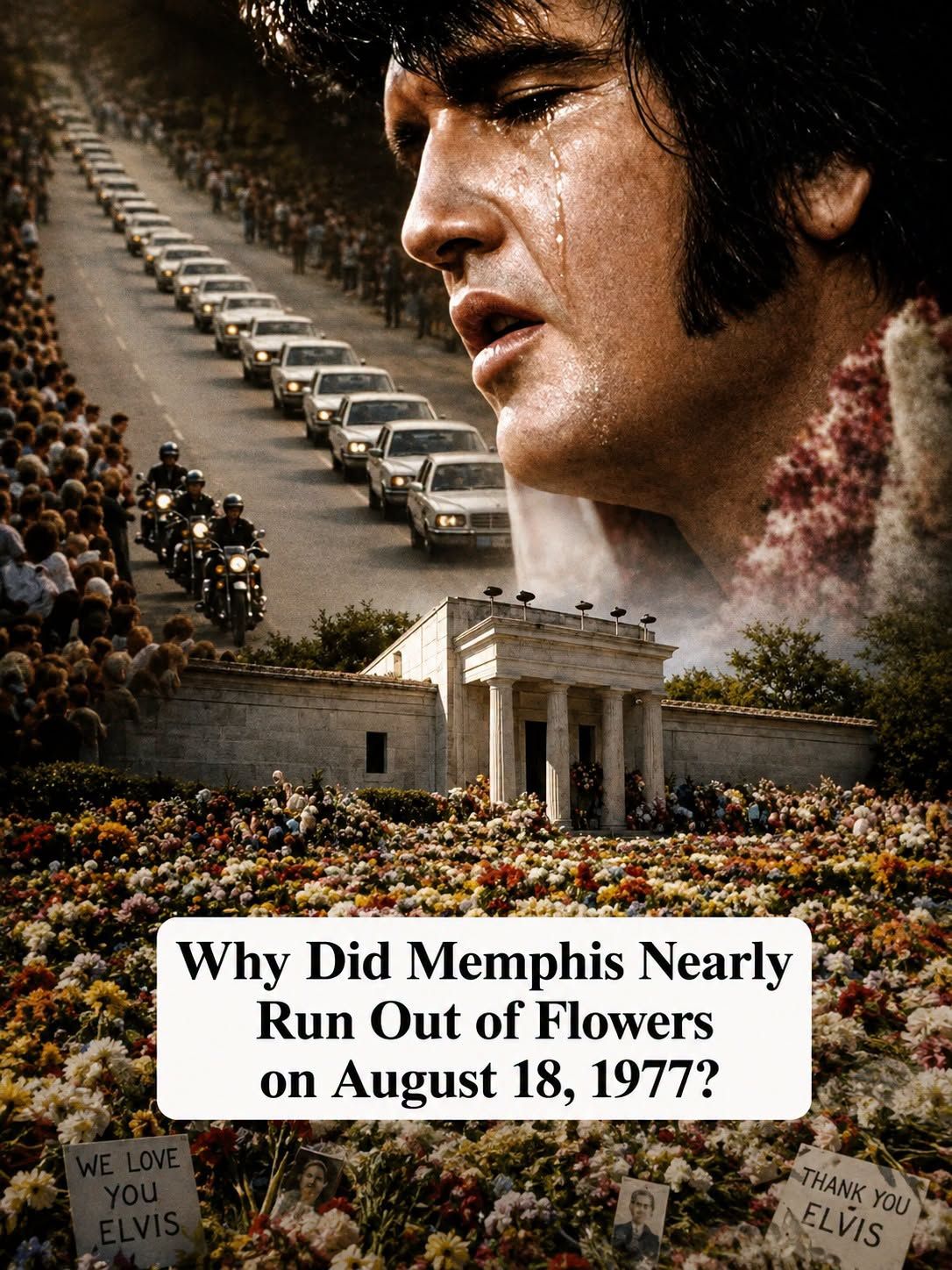
There are moments in music history when statistics suddenly become inadequate. Album sales, chart positions, sold-out concerts, and television audiences can measure fame, but they cannot fully explain what happens when millions of people feel that a familiar voice has disappeared from their lives. Few scenes illustrate that truth more vividly than Memphis on August 18, 1977, when the city prepared to say goodbye to Elvis Presley. Only two days after his death at the age of 42, the streets surrounding Graceland became the setting for an extraordinary public farewell, one marked not only by crowds and silence, but by an astonishing sea of flowers.
For a generation that had watched Elvis rise from a young Southern singer into one of the most recognizable entertainers in the world, the news of his passing was difficult to absorb. He had been more than a recording artist. His voice had accompanied first dances, long automobile journeys, family gatherings, military years, youthful dreams, and the quiet evenings of adulthood. Songs such as “Love Me Tender,” “Can’t Help Falling in Love,” “Are You Lonesome Tonight?” and “How Great Thou Art” had become woven into the memories of people who had grown older alongside him. When that voice was suddenly gone, many listeners responded as though a familiar chapter of their own lives had closed.
That helps explain why Memphis nearly ran out of flowers on August 18, 1977.
As thousands of mourners traveled toward Graceland and the funeral route, floral tributes began arriving in extraordinary numbers. Fans who could not make the journey to Tennessee searched for another way to participate in the farewell. They telephoned florists. They ordered wreaths, bouquets, sprays, and arrangements. Flowers arrived from admirers, friends, organizations, and communities from far beyond Memphis. Contemporary accounts have long described local flower shops facing intense demand as orders accumulated faster than ordinary supplies could comfortably meet.
The image is powerful because it feels almost impossibly human. There was no social media, no instant worldwide livestream, and no digital memorial wall where millions could leave a message within seconds. In 1977, grief often required something physical. A handwritten card. A long-distance telephone call. A journey across several states. Or, in this case, flowers sent to Memphis with the hope that they might somehow express what words could not.
And so the flowers became more than decoration.
They became a language.
Each arrangement seemed to carry an unspoken message: Thank you for the songs. Thank you for the memories. Thank you for being there during a part of my life.
That distinction matters when considering the legacy of Elvis Presley. His commercial achievements were enormous, and his influence on popular music remains difficult to overstate. Yet numbers alone can make an artist seem distant. Gold records hanging on walls cannot explain why strangers stood together in the Memphis heat. Attendance figures cannot explain why people traveled hundreds of miles simply to stand near Graceland. Chart history cannot explain why so many floral orders arrived that the flowers themselves became part of the visual memory of his funeral.
The answer lies in the relationship between an artist and an audience. Elvis entered homes through records, radio broadcasts, films, and television appearances during an era when popular culture was becoming increasingly shared across generations and geography. For countless listeners, he represented youth, possibility, rebellion, gospel tradition, romance, family memory, and eventually nostalgia. People did not all love Elvis for the same reason, but many felt that some part of their personal history had been accompanied by his voice.
That is why the sight of Memphis overwhelmed by floral tributes still carries emotional force nearly five decades later.
Flowers are temporary. They bloom, they fade, and eventually they disappear. Yet perhaps that very fragility made them the perfect symbol for the moment. Fame can appear permanent while a human life is not. On August 18, 1977, Memphis witnessed that contradiction on an unforgettable scale. One of the most famous men in the world was being laid to rest, while ordinary people attempted to answer an extraordinary loss with the simplest gesture they knew.
A city nearly running out of flowers tells us something that sales figures never can.
It tells us that people were not merely mourning a superstar.
They were saying goodbye to Elvis Presley, a voice that had lived inside their memories—and, for many of them, felt remarkably close to home.