Introduction
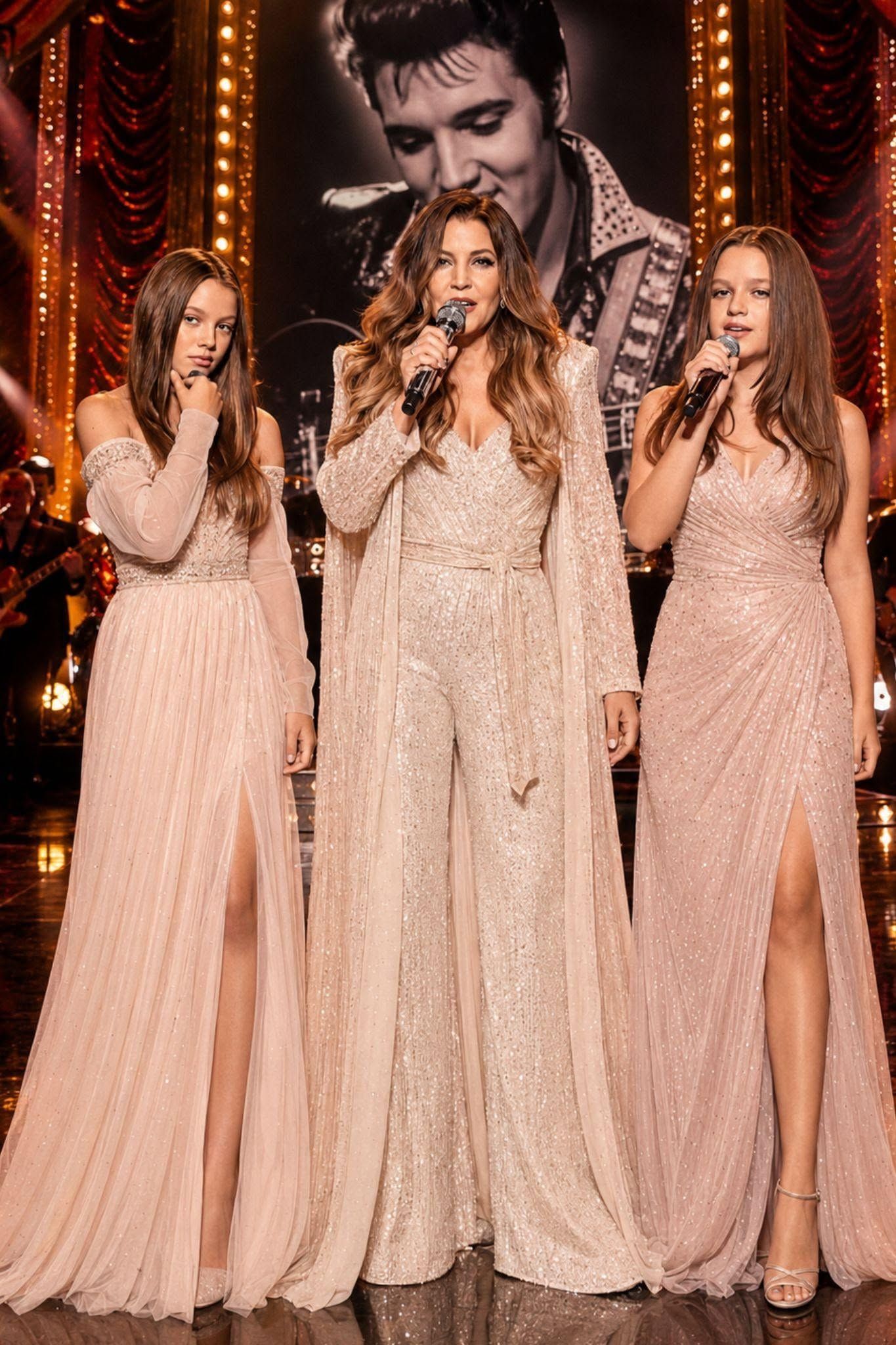
Some songs belong to a particular year. Others belong to an artist, an album, or a memory. But a rare few seem to outlive every boundary placed around them. Elvis Presley’s “Can’t Help Falling in Love” is one of those extraordinary recordings—a song that began as a tender moment in the early 1960s and gradually became something much larger: a musical bridge between generations.
More than six decades after Elvis first recorded it, the song remains inseparable from the Presley name. The voice that introduced it to millions is gone. Elvis Presley is gone, and so is his daughter, Lisa Marie Presley. Yet the family story did not end with their passing. It continues through Riley Keough, Harper Lockwood, and Finley Lockwood, descendants who live in a world Elvis himself never saw, but within a family history that still carries his extraordinary cultural weight.
That is what makes the song feel different today.
When Elvis sings those unmistakable opening words, listeners are not simply hearing a famous recording from another era. They are hearing a young artist whose voice would eventually become part of American cultural memory. There is restraint in the performance, almost surprising when compared with the electrifying stage persona that helped make him famous. Elvis does not overpower the melody. Instead, he allows it to unfold gently, giving every phrase space to breathe.
That simplicity may explain why “Can’t Help Falling in Love” has endured so powerfully.
The arrangement never needs to announce its importance. The melody moves patiently, while Elvis sings with warmth rather than spectacle. It is a performance built on control, vulnerability, and an understanding that sometimes the quietest song in the room becomes the one people remember longest.
For the Presley family, however, its meaning inevitably extends beyond music.
Riley, Harper, and Finley never knew their grandfather during his lifetime. Their connection to him exists through family stories, photographs, recordings, places, and the remarkable public legacy surrounding the Presley name. Yet music has a peculiar ability to overcome that distance. A photograph captures a moment, but a recording gives that moment sound. Elvis’s voice can still fill a room exactly as it did decades ago.
And suddenly history does not feel quite so distant.
For Riley Keough, whose own artistic life has included acting, producing, and music, the inheritance is especially fascinating. She belongs to a generation that must navigate the complicated territory between honoring a legendary family name and establishing an independent identity. Harper and Finley, meanwhile, have grown up with an even greater chronological distance from their grandfather, yet the songs remain available to them in precisely the same form heard by millions of listeners around the world.
That continuity gives “Can’t Help Falling in Love” an almost ceremonial quality.
It has survived changing fashions, changing technologies, and changing generations of listeners. Vinyl became cassette, cassette became compact disc, and physical recordings gave way to streaming. Yet the emotional architecture of the song remains untouched. Elvis begins singing, the melody rises, and for a few minutes the decades collapse.
Perhaps that is the most remarkable element of the Presley legacy. Buildings preserve history. Photographs preserve appearances. Archives preserve documents. But music preserves presence.
When Elvis Presley’s voice emerges from the speakers, he is no longer merely a figure in black-and-white photographs or a name written into music history. For those few minutes, he becomes audible again.
And for the generations that followed him—including Lisa Marie Presley, Riley Keough, Harper, and Finley—that voice represents something no inheritance document could ever fully describe.
It is family history set to melody.
That is why THE SONG ELVIS LEFT BEHIND—AND THE PRESLEY GENERATION STILL CARRYING HIS VOICE FORWARD is ultimately about more than nostalgia. It is about the strange permanence of recorded music and the way one performance can continue speaking long after its singer has left the stage.
Elvis could never have known exactly how people would hear “Can’t Help Falling in Love” more than sixty years later. He could not have imagined every wedding, memorial, tribute, television performance, family gathering, or quiet evening in which the song would return.
But perhaps that uncertainty is part of its beauty.
The Presley family has experienced extraordinary fame as well as profound loss. Through all of it, the music has remained—unchanged, patiently waiting for another listener to press play.
And when those opening notes begin again, something remarkable happens.
Graceland’s past and the Presley family’s future seem to occupy the same room.
The grandfather they never met begins to sing.
The years disappear.
And one of the most recognizable voices of the twentieth century continues moving forward, carried not only by records and history books, but by the generations who still bear the Presley name.