Introduction

For generations of visitors, walking through the gates of Graceland has felt like entering a place suspended between history and memory. People arrive expecting to encounter Elvis Presley, the revolutionary performer whose voice transformed popular music and whose image became one of the most recognizable in the world. They come to see the famous stage costumes, the gold records, the automobiles, the private aircraft, and the rooms associated with a life lived under extraordinary public attention. Yet hidden among those celebrated symbols of success was an exhibit that offered something far more intimate and emotionally revealing. It was the room inside Graceland that changed how fans saw Elvis forever.
This was not primarily a story about record sales, sold-out concerts, or the dazzling confidence of the man known as the King of Rock and Roll. Instead, the exhibit invited visitors to consider Elvis in a role that mattered deeply to him but was rarely visible beneath the bright lights: Elvis Presley as a father. Through objects connected to the childhood of Lisa Marie Presley, the public was given a quiet glimpse into a private relationship that fame could never fully explain.
Among the most moving items were Lisa Marie’s childhood belongings, personal photographs, and a simple message signed “Daddy.” These modest treasures carried none of the theatrical grandeur normally associated with Elvis. There were no dramatic spotlights and no roaring crowds. Their power came from their simplicity. Each object suggested ordinary moments between a father and his young daughter—moments of affection, protection, laughter, and separation that belonged not to the legend, but to the man.
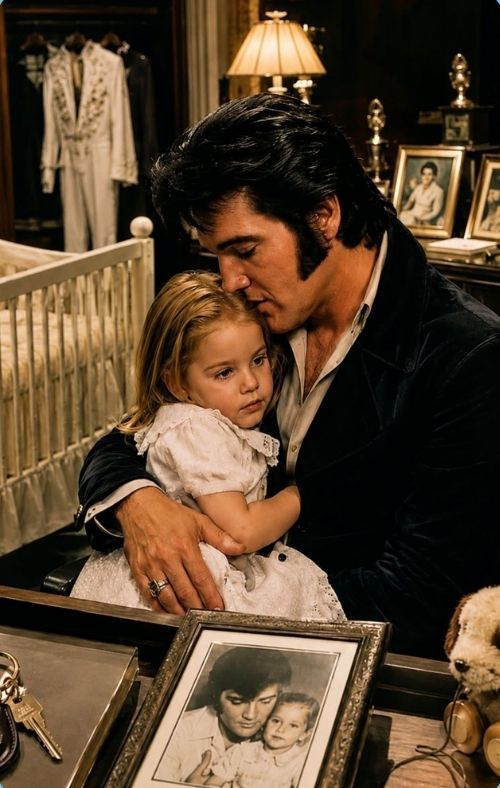
Perhaps the most affecting discovery was the photograph of Lisa Marie that Elvis reportedly carried in his wallet. For many visitors, that small picture expressed more than any elaborate display could have done. It suggested that wherever Elvis traveled, amid the concerts, the hotel rooms, the demanding schedules, and the constant pressure of public life, his daughter remained close to him. The photograph was not intended for an audience. It was a personal reminder carried by a father whose life often kept him away from home.
For fans who had long admired Elvis as an entertainer, this private detail offered a profound change in perspective. The stage had shown them his charisma, confidence, generosity, and remarkable ability to command a room. The exhibit showed them his tenderness. It revealed that behind the carefully styled hair, the famous jumpsuits, and the enduring mythology was a parent who understood the deep emotional responsibility of loving a child.
The story also carried an unavoidable sadness. Lisa Marie Presley was only nine years old when her father died in August 1977. Her memories of him would therefore remain tied to a childhood that ended far too quickly. The objects displayed at Graceland became more than historical artifacts; they became fragments of a relationship interrupted by loss. Every handwritten note, photograph, and childhood possession seemed to preserve a conversation that time could no longer continue.

That is why this exhibit affected visitors so deeply. It did not ask them merely to admire Elvis. It asked them to understand him. It reminded them that public figures are often remembered through performances and headlines, while their most important relationships unfold quietly, far from public view. In this room, visitors were no longer looking only at the King. They were looking at a father whose love for his daughter survived through the small things he left behind.
This was not just memorabilia. It was love preserved in silence, memory, and heartbreak. The room offered a rare and deeply human portrait of the man behind the myth, seen through the eyes of the daughter who never stopped loving him. Long after the music faded and visitors continued through the halls of Graceland, that quiet image remained: not Elvis standing before thousands of cheering fans, but a devoted father carrying his little girl’s photograph close to his heart.