Introduction
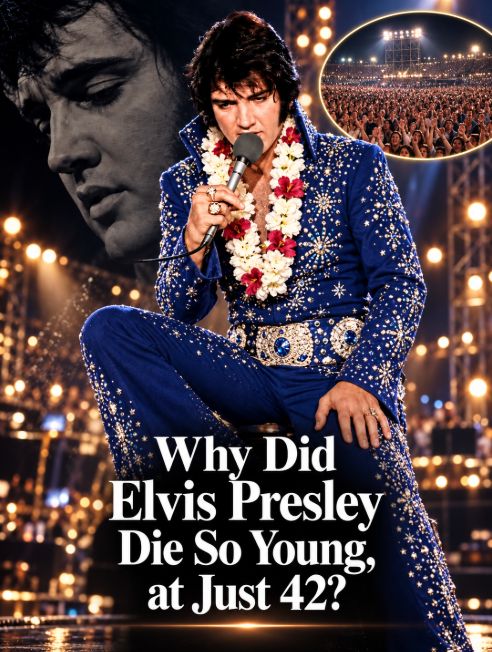
Elvis Presley was only 42 when he died, yet the circumstances surrounding his final years suggest that his death was not simply an unexpected tragedy occurring without warning. Behind the familiar explanation of a failing heart lies a far more complicated story—one involving serious illness, physical exhaustion, prescription medication, and a demanding professional schedule that continued even as his health visibly deteriorated.
By 1977, Elvis was no longer the seemingly tireless young performer who had transformed popular music two decades earlier. He remained capable of extraordinary moments onstage, and his voice could still carry remarkable emotional weight. However, those closest to him were witnessing a man struggling with severe sleep disruption, chronic gastrointestinal difficulties, dramatic fluctuations in his appearance, and several other medical problems. He was often exhausted, yet the machinery surrounding his career continued to move forward.
That is one of the most troubling elements of the story. On the day he died, Elvis was preparing to begin another tour. His luggage was reportedly ready, the travel arrangements had been made, and another sequence of concerts awaited him. The public saw a legendary entertainer who was still working. Behind the gates of Graceland, however, his body was under enormous strain.

For many years, the simplest explanation was that Elvis Presley’s heart gave out. That description may capture the immediate medical crisis, but it does not fully explain how a man of only 42 reached such a dangerous condition. Later discussion of his health has examined several overlapping factors rather than identifying one neat and uncontested cause.
Elvis reportedly suffered from cardiovascular problems, high blood pressure, liver damage, glaucoma, and an enlarged colon. His chronic constipation and gastrointestinal illness have received particular attention because of where he was found: inside his bathroom at Graceland on August 16, 1977. Some medical commentators have proposed that intense straining could have triggered a fatal cardiac event in a person whose heart and general health were already badly compromised. This remains an interpretation rather than a universally accepted final answer, but it adds an important dimension to the traditional account.
Prescription medication further complicated the picture. Numerous substances were identified in his system, although disagreement has continued over precisely how much each one contributed to his death. The more responsible conclusion is not that one medication alone explains everything, but that multiple prescriptions, underlying disease, exhaustion, and physical decline may have created a dangerously unstable combination.
The warning signs had been visible for years. Elvis was hospitalized on several occasions, experienced difficulty maintaining a regular sleeping pattern, and sometimes appeared unwell during performances. Friends and members of his professional circle reportedly recognized that his condition was worsening. Yet stopping the concerts would have required confronting not only Elvis himself, but also the expectations, financial pressures, and loyalties surrounding one of the most famous entertainers in the world.
This is why the story remains so haunting. Elvis was surrounded by people, but fame can create its own form of isolation. A superstar may have assistants, doctors, friends, and admirers nearby while still lacking someone with enough authority—or enough influence—to bring the entire operation to a halt.
The final question, therefore, is larger than “What killed Elvis Presley?” His death appears to have resulted from a deeply complicated convergence of poor health, prescription-drug dependence, chronic medical conditions, and relentless pressure. The immediate event may have occurred suddenly, but the decline leading toward it did not.
Elvis Presley’s final years should not erase his achievements. His voice, cultural influence, generosity, and ability to communicate emotion remain central to his legacy. But understanding the difficult truth behind his death allows us to see him more fully—not merely as the King of Rock and Roll, but as a vulnerable human being whose body had been sounding alarms long before the world finally listened.