Introduction
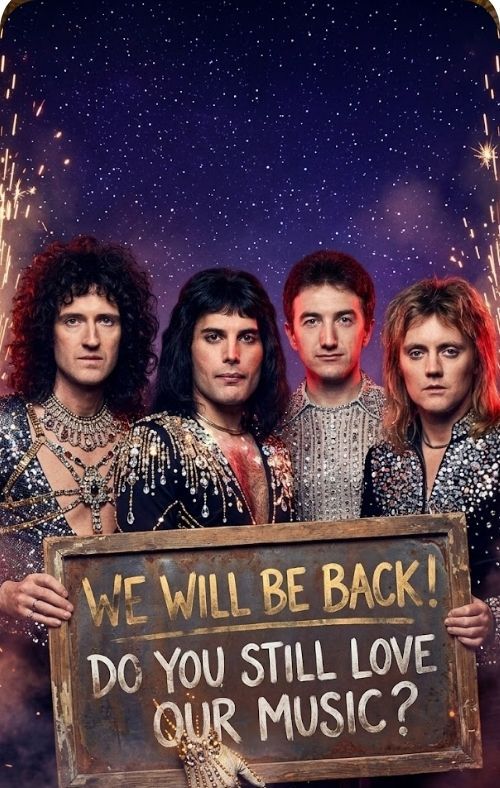
There are songs that people admire, and then there are songs that seem to leap out of the speakers and take hold of the room. Queen – Don’t Stop Me Now belongs firmly in that second category. From its very first notes, it announces itself not with caution, but with momentum. It does not ask for permission to be enjoyed. It simply begins moving, smiling, racing forward—and if the listener is willing, it carries them with it. That may be one of the reasons the song has endured so powerfully across generations. It offers not just melody, but lift. Not just performance, but release.
For older listeners in particular, that kind of energy can feel especially meaningful. With time, people learn that joy is not always loud in life. Often, it becomes quieter, more reflective, more hard-earned. That is why a song like Queen – Don’t Stop Me Now can strike such a deep chord. Beneath its dazzling pace and bright theatrical flair, it captures something people of all ages understand but perhaps appreciate more deeply with experience: the rare and exhilarating feeling of being fully alive in a moment.
What makes the song remarkable is how effortlessly it creates that sensation. The piano line does not merely accompany the vocal; it propels the entire piece like an engine. The rhythm section keeps everything moving with confidence, while the arrangement gives the song space to feel grand without becoming heavy. There is sophistication in how it is built, but it never sounds burdened by its own craft. That is one of Queen’s great gifts as a band. They could be musically ambitious without sounding distant. Even when the structure was polished, the emotion remained immediate.
And then, of course, there is Freddie Mercury. His voice in Queen – Don’t Stop Me Now is not simply strong—it is radiant. He sounds as though he is singing from the center of pure momentum, where delight, freedom, and self-belief all meet. There is mischief in the performance, but also command. Mercury knew how to make exuberance feel intelligent. He did not reduce joy to something shallow. He made it feel expansive, almost triumphant. That is a harder thing to achieve than it may first appear. Many upbeat songs can sound disposable. This one sounds unforgettable.
Part of the song’s enduring appeal lies in that balance. It is playful, but not foolish. It is energetic, but not chaotic. It is theatrical, but never empty. Even listeners who have heard it countless times often find themselves smiling when it begins, because the performance feels genuinely alive. It has the rare quality of sounding as if it is enjoying itself. That spirit reaches people immediately, and it continues to reach them decades after its release.
For many mature listeners, Queen – Don’t Stop Me Now also carries the emotional texture of memory. It may bring back an era when music felt adventurous, when radio still delivered surprises, when a great song could instantly brighten a day or transform a drive, a gathering, or an ordinary afternoon. But nostalgia alone cannot explain why it continues to resonate with new generations. The deeper reason is that the song still works. Its vitality has not faded. Its craftsmanship still holds. Its emotional spark still feels real.
There is also something quietly admirable about the song’s refusal to apologize for pleasure. In a world that can often feel heavy, skeptical, or overly guarded, Queen – Don’t Stop Me Now remains gloriously open-hearted. It celebrates motion, excitement, and the thrill of feeling unstoppable, if only for a few minutes. That message may sound simple, but simple truths are often the ones that last.
In the end, this is not just one of Queen’s most entertaining recordings. It is one of their most liberating. Queen – Don’t Stop Me Now endures because it reminds listeners that music can do more than express sorrow or reflection. It can also restore energy. It can revive the spirit. It can make the heart feel lighter. And long after the song ends, that feeling lingers—which is perhaps the clearest sign of a classic.