Introduction
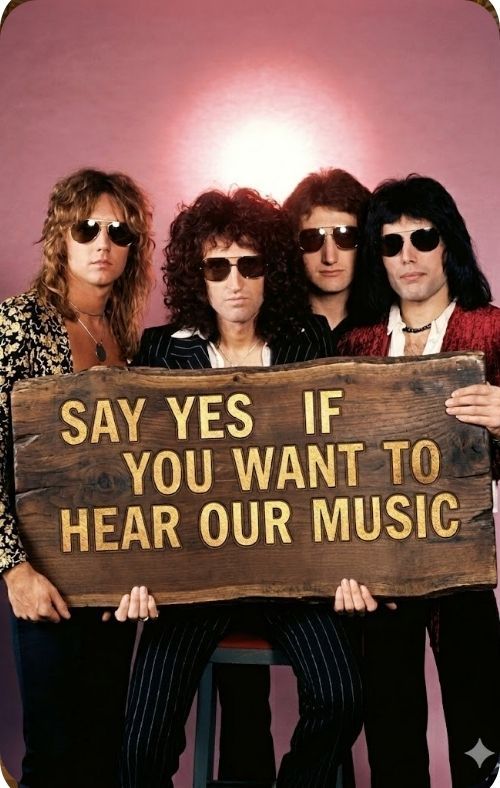
There are famous songs, and then there are songs that seem to stand outside the ordinary rules of popular music altogether. Queen – Bohemian Rhapsody belongs to that second category. It is not simply one of Queen’s greatest recordings. It is one of those rare works that feels as bold, strange, theatrical, and thrilling today as it did when audiences first heard it. Decades later, it still stops listeners in their tracks—not because it follows the usual formula for a hit, but because it dares to ignore every formula and somehow becomes unforgettable because of it.
What makes Queen – Bohemian Rhapsody so extraordinary is that it never behaves like a normal rock song. It opens like a confession, drifts into something almost operatic, erupts into hard rock, and then closes with a sense of resignation that feels almost haunting. On paper, that structure sounds impossible. In practice, it is masterful. The song moves like a dramatic short film told entirely through sound. Each section has its own mood, its own tension, its own personality—yet all of it holds together with astonishing confidence.
For older and more experienced listeners, that may be part of the song’s lasting appeal. It does not treat the audience as passive. It asks you to listen closely. It asks you to feel the shifts, the mystery, the tension, and the release. It rewards patience. And over time, many people find that the song grows richer with age. What may once have sounded eccentric or flamboyant begins to reveal itself as deeply crafted, musically intelligent, and emotionally layered.
Of course, no discussion of Queen – Bohemian Rhapsody can avoid the presence of Freddie Mercury, whose performance remains one of the great achievements in rock history. Mercury does not merely sing the song—he inhabits it. There is command in his voice, but also vulnerability, wit, drama, and a kind of fearless emotional reach that very few singers have ever possessed. He could make the song feel enormous without ever losing its human center. That is one reason the record continues to resonate so deeply. Beneath its spectacle, there is still a beating heart.
The genius of the song also lies in Queen as a band. Brian May, Roger Taylor, and John Deacon do not simply accompany Mercury; they help construct an entire world around him. The harmonies are rich and layered, the guitar work is elegant and explosive when needed, and the rhythmic control is so precise that even the most unusual transitions feel natural. This is not chaos. It is discipline disguised as drama. The more one listens, the clearer it becomes that every strange turn, every vocal stack, every sudden shift was built with care.
Another reason Queen – Bohemian Rhapsody remains beloved is that it represents a period when artists were willing to take enormous risks. It is hard to imagine many songs of this scale and ambition being approved in a cautious commercial environment. Yet Queen trusted the song, and listeners rewarded that courage. In doing so, they proved that audiences will embrace something unconventional when it is done with brilliance and conviction.
For many older readers, the song also carries the weight of memory. It may call back to a first hearing on the radio, a family record player, a late-night television performance, or a time when rock music felt especially adventurous. But nostalgia alone cannot explain its power. Plenty of old songs are remembered fondly; far fewer still feel alive. Queen – Bohemian Rhapsody feels alive because it still surprises. It still commands attention. It still sounds like nothing else.
In the end, that may be the clearest measure of its greatness. It is not just admired because it was successful. It is admired because it was fearless. It took imagination, musicianship, theatrical instinct, and emotional daring and turned them into something permanent. Long after trends have faded and musical fashions have changed, Queen – Bohemian Rhapsody remains what it has always been: a wildly original masterpiece that reminds us just how thrilling music can be when artists refuse to think small.