Introduction
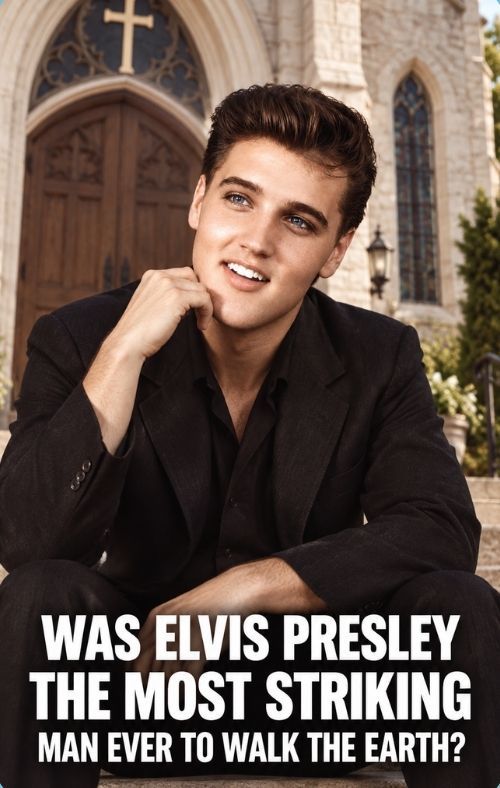
For decades, the image of Elvis Presley has been preserved in photographs, concert films, television appearances, and countless magazine covers. His jet-black hair, unmistakable profile, expressive blue eyes, and carefully tailored stage clothes became part of the visual language of twentieth-century popular culture. Yet an intriguing idea has followed Elvis almost as persistently as his music: the photographs never quite captured what it was like to see him in person. Again and again, people who actually met him described an impression that went beyond physical appearance. They spoke of presence, warmth, nervous energy, courtesy, and a strangely powerful combination of confidence and vulnerability.
Perhaps no testimony is more revealing than that of Priscilla Presley, who once remembered their first meeting with the simple observation that “He was more handsome than he looked in films.” It is a remarkable statement considering how carefully Elvis had already been photographed and presented to the public. She would also describe him as “gorgeous,” while emphasizing that his appeal was not merely a matter of appearance. What mattered just as much, she suggested, was “a great heart” and “a great soul.” Those words offer a useful way of understanding why memories of Elvis often sound different from ordinary celebrity recollections. People did not simply remember seeing a handsome movie star. They remembered how the atmosphere seemed to change around him.
A journalist who encountered Elvis backstage during his celebrated 1969 Las Vegas comeback offered another striking description, calling him “incredibly handsome” and suggesting that he possessed “possibly the best film profile since Rudolph Valentino.” Yet the account became more interesting when it moved beyond appearance. Elvis reportedly stood to greet visitors enthusiastically, showed signs of nervousness, and displayed the courtesy associated with a traditional Southern gentleman. That contrast is essential to understanding his appeal. Beneath one of the most famous faces in entertainment was a man who could appear surprisingly shy, eager to please, and deeply aware of the people around him.
The same pattern appears in memories from those who worked beside him. Barbara Eden, Elvis’s co-star in Flaming Star, has continued to remember him not as an overbearing superstar but as respectful, hardworking, and serious about his craft. She described him as “a lovely man” and a gentleman, emphasizing that the enormous fame surrounding Elvis did not translate into an oversized ego on the set. More than sixty years later, such recollections are important because they reveal what survived after the costumes, publicity campaigns, and movie premieres became history. What remained was the memory of how he treated people when the cameras were not rolling.

That may be the most fascinating element of the Elvis legend. His physical appearance was undeniably part of his success, but Elvis Presley’s charisma was never simply about his face. It was the combination that people found difficult to describe: movie-star features paired with visible sensitivity, enormous fame paired with old-fashioned manners, commanding stage presence paired with occasional shyness. These contradictions made him seem more human even while his celebrity was becoming larger than life.
Photographs can preserve cheekbones, hairstyles, costumes, and smiles. Film can preserve movement and voice. But neither medium can perfectly capture what happens when another person walks into a room and immediately changes its emotional temperature. That seems to be what so many eyewitnesses were trying to explain when they remembered Elvis.
Priscilla Presley saw someone more striking than the photographs suggested. Journalists saw a remarkable movie-star face combined with unexpected vulnerability. Barbara Eden remembered kindness, discipline, and professionalism long after the glamour had faded. Together, those memories suggest that Elvis’s enduring appeal cannot be reduced to nostalgia or handsome photographs.
He may have been one of the most photographed men of his generation, but according to the people who actually stood in front of him, the camera was always leaving something out.
And perhaps that missing quality—the mixture of beauty, vulnerability, kindness, discipline, and unmistakable charisma—is exactly why, nearly half a century after his final years, Elvis Presley still seems unlike almost anyone who came before or after him.