Introduction

IN 1962, PATSY CLINE DID WHAT NO WOMAN IN COUNTRY MUSIC HAD EVER DONE — AND SHE DID IT FOR 35 STRAIGHT NIGHTS.
There are moments in music history that do not arrive with the noise of revolution, but with one woman standing beneath a spotlight, trusting her voice to do what no announcement ever could. For Patsy Cline, that moment came in 1962, on the glittering Las Vegas Strip, inside the Mint Casino — a place built on bright lights, big risk, and the kind of showmanship that could swallow a lesser performer whole. But Patsy was not there to be swallowed. She was there to prove something.
By then, country music already knew her power. Her voice had carried heartbreak with a smoothness that felt almost impossible — rich, controlled, wounded, and dignified all at once. But Las Vegas was a different stage. It was not the familiar comfort of a country audience gathered close to the radio or sitting in a Southern theater. Vegas demanded presence. It demanded stamina. It demanded the ability to hold a room night after night, not as a novelty, not as a supporting act, but as the star.
And Patsy Cline did exactly that.
For 35 straight nights, she stood under those lights as the first female country artist to headline her own Las Vegas show. That achievement alone would be enough to secure her place in history, but what makes the story unforgettable is how human it remained. Behind the glamour was her mother, Hilda, standing close to the center of it all. Hilda was not simply a proud parent watching from a distance. She had helped shape Patsy’s public image with her own hands, sewing stage costumes stitch by stitch, adding care and dignity to every seam. In a city obsessed with sparkle, Patsy carried something more meaningful than glitter. She carried family.
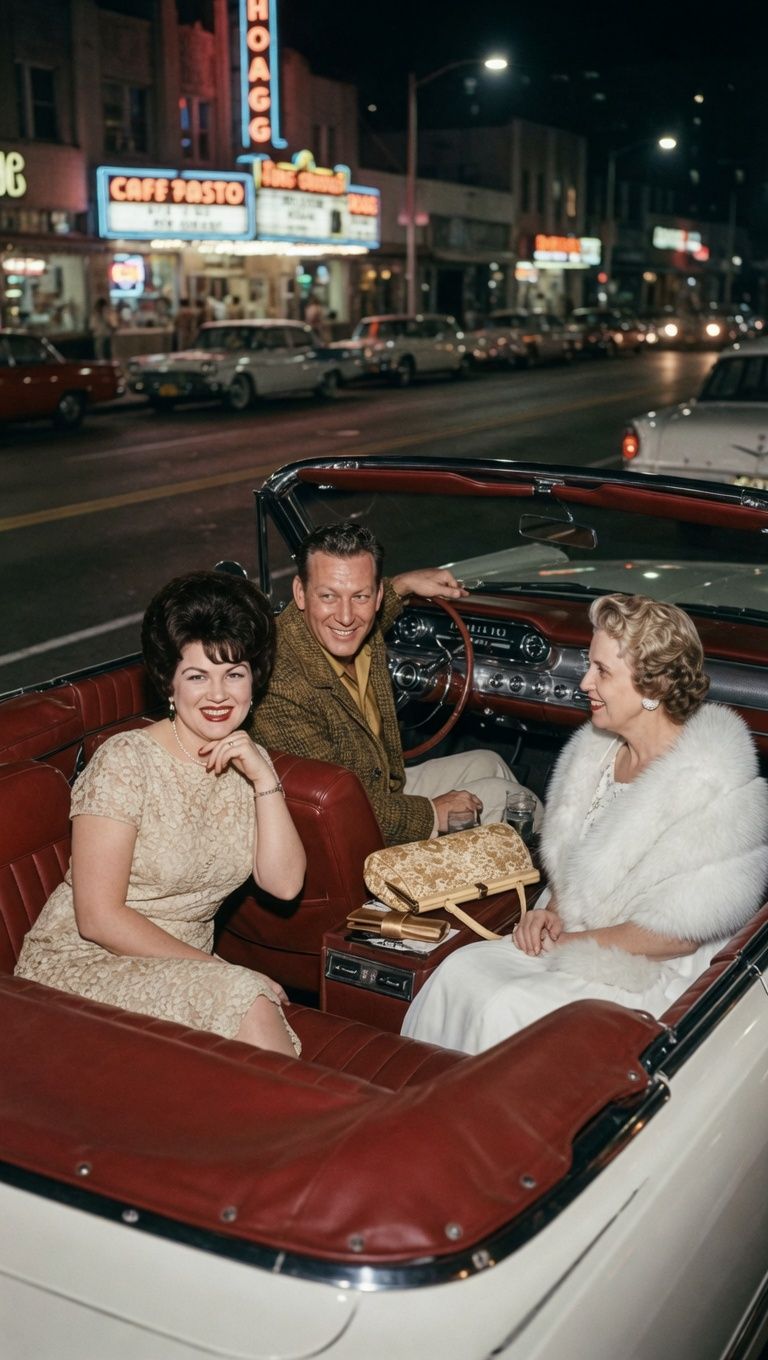
That is why the image of Patsy standing with Hilda and rockabilly legend Carl Perkins feels so quietly powerful. It is not just a photograph of famous people. It is a small golden pause inside a demanding chapter — a daughter, her mother, and a fellow musician caught in a moment before history fully understood what it was witnessing. Patsy smiles, but behind that smile is a woman pushing country music into rooms where it had not always been welcomed with open arms.
What separated Patsy from so many singers was not volume or spectacle. It was emotional authority. She could make a lyric feel lived-in without forcing it. She could stand still and command attention. Her voice had the rare ability to sound polished and deeply personal at the same time. In Las Vegas, that quality mattered. Surrounded by lights, noise, and show-business pressure, Patsy did not become less country. She made country music bigger.
Those 35 nights were not just performances. They were proof. Proof that a woman in country music could headline, lead, endure, and define a stage on her own terms. Proof that elegance did not need to be soft, and strength did not need to be loud. Proof that Patsy Cline was not merely a great singer of her time — she was a bridge between what country music had been and what it could become.
And yet, among all those nights, one performance still seems to rise above the rest. Perhaps because it captured everything Patsy represented: the courage, the ache, the discipline, the grace, and that unforgettable voice that could quiet a room before the first note had fully settled. Decades later, people still talk about it because Patsy Cline did not just sing in Las Vegas. She walked into the brightest city in America and made it listen.