Introduction
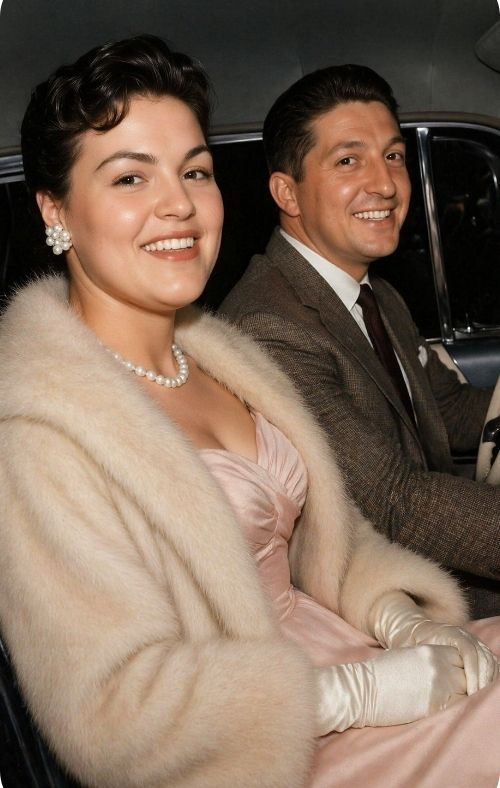
Some love stories become legendary because they are gentle, polished, and easy to admire from a distance. Others endure because they are far more human than that. They are untidy, passionate, imperfect, and marked by the kind of emotional intensity that leaves traces on everything they touch. The story of Patsy Cline and Charlie Dick belongs to the second kind. It does not survive in memory because it looked like a fairytale. It survives because it felt real. And in the case of Patsy Cline, that reality did not stay confined to her private life. It entered her music, deepened her performances, and helped create the emotional force that listeners still feel decades later.
That is why the story framed in Patsy Cline TURNED HIM DOWN ON A DANCE FLOOR IN 1956 — ONE YEAR LATER, SHE MARRIED HIM. carries such immediate power. It begins almost like a scene from a film: a dance hall in Winchester, Virginia, cigarette smoke in the air, music filling the room, and a man walking straight toward a woman who already seemed to belong to the stage. Charlie Dick asked Patsy to dance, and she answered with cool finality: she was working. For many men, that would have been the end of the moment and the end of the story. But Charlie stayed. He returned. He kept showing up. Somewhere between persistence and undeniable chemistry, something changed. What looked at first like refusal slowly became recognition.

And perhaps that is part of what makes this story so compelling to older listeners who understand that lasting love is rarely simple. Real relationships are not built out of perfect timing alone. They are often forged in friction, misunderstanding, attraction, loyalty, pride, and the strange pull two people feel even when they know life may not become easier by joining together. Patsy and Charlie’s marriage was not a polished romance designed for admiration. It was a union full of energy, tension, argument, devotion, and heartbreak. It carried the strain of ambition and the pressure of fame. His jealousy reportedly collided with her growing success. Their love did not erase conflict. If anything, it intensified it.
But that emotional intensity also helps explain why Patsy Cline’s voice still feels so devastatingly personal. She did not sing heartbreak as a distant concept. She sang it like someone who understood contradiction from the inside. Her performances hold sorrow, strength, yearning, pride, and bruised tenderness all at once. That combination is rarely accidental. It usually comes from life itself. When we listen to Patsy, we are not just hearing technical excellence. We are hearing feeling refined by experience. The cracks in her personal life did not weaken the emotional truth in her art; they deepened it. That is why so many of her songs still sound less like performances and more like confessions.
The phrase Patsy Cline TURNED HIM DOWN ON A DANCE FLOOR IN 1956 — ONE YEAR LATER, SHE MARRIED HIM. is striking not only because of its dramatic reversal, but because it opens the door to everything that followed: a marriage that was loud, messy, loving, wounded, resilient, and profoundly human. There is something deeply moving in the idea that the man she first refused became the man whose presence would shape so much of her emotional world. Their story reminds us that love is not always born in ease. Sometimes it begins with resistance. Sometimes it grows through conflict. And sometimes its deepest meaning is only fully understood after loss.
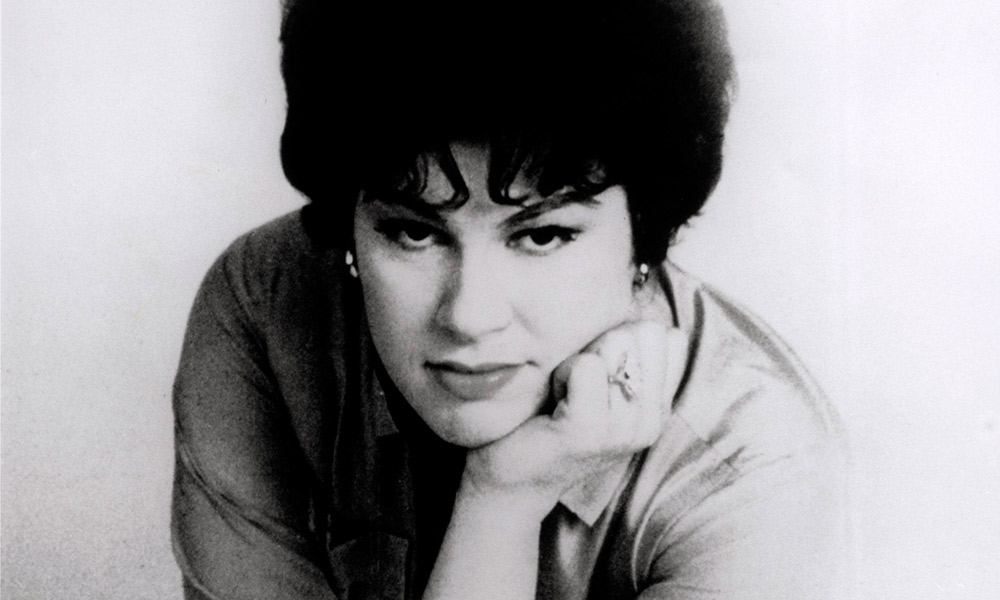
Then came the terrible final turn in 1963, when country music lost Patsy Cline far too soon. In the years that followed, the silence around her absence became part of the story too. For Charlie Dick, the woman who once turned him away on a dance floor was no longer a rising star, no longer a voice on the stage, but a memory that remained impossibly alive. The idea that he never remarried adds another layer of gravity to this story, not because it turns it into myth, but because it suggests a bond that survived even death in the quietest way possible. Sometimes devotion is not loud. Sometimes it reveals itself through what a person chooses not to replace.
In the end, Patsy Cline’s story continues to matter because it was not flawless. It was lived. It was complicated. It carried desire, disappointment, devotion, and grief. And that is precisely why her music still reaches people who have lived long enough to know that the most unforgettable voices are often shaped not by perfection, but by pain, resilience, and love that refused to stay simple. Patsy Cline did not just sing about life. She sang from inside it. And listeners can still hear that truth in every note.
Patsy Cline TURNED HIM DOWN ON A DANCE FLOOR IN 1956 — ONE YEAR LATER, SHE MARRIED HIM. In the end, that unexpected beginning became the first line in a love story whose emotional echoes never really left country music at all.