Introduction
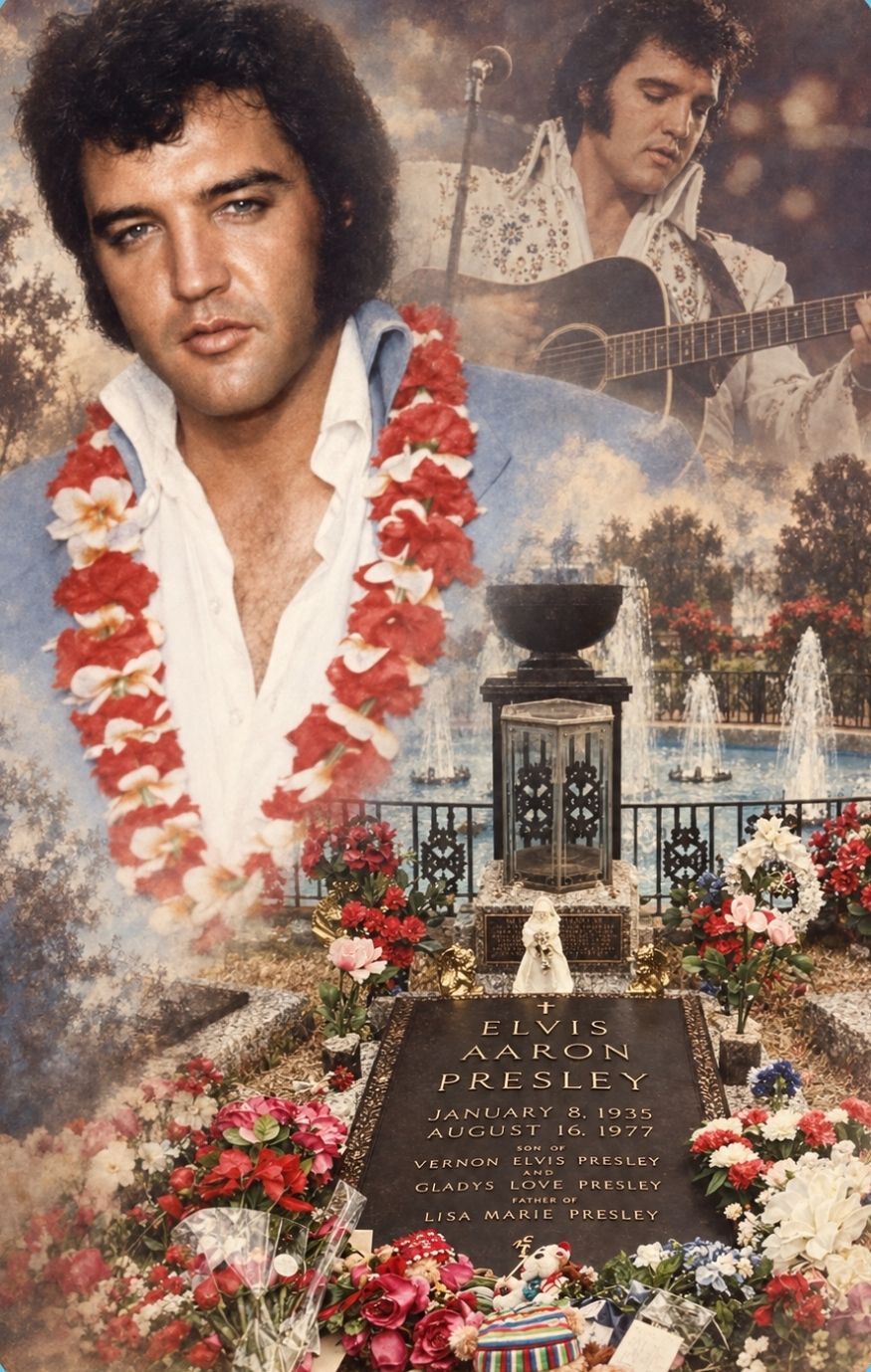
There are places where music seems to linger even when no record is playing. For those who love Elvis Presley, Graceland’s Meditation Garden carries that quiet emotional weight. A visitor may arrive remembering the excitement of his early recordings, the warmth of a familiar ballad, or a song that once filled a family living room. Standing before his resting place, those memories become something more personal: a meeting between the voice preserved on record and the years that have passed in our own lives.
The supplied video, “This SHOCKING Announcement About Elvis Presley’s Tomb Will Leave You In Tears,” builds its story around an alleged announcement about relocating his memorial. However, the transcript does not provide a verifiable original statement, and I could not confirm that announcement in the official sources checked. Graceland’s own published information identifies the Meditation Garden as the resting place of Elvis and members of his family. Its account of their burial records that Elvis and his mother, Gladys Presley, were buried there in October 1977. The video’s suggestions of an empty grave or a concealed survival should therefore be treated as unsupported speculation. graceland.com
Yet beneath the video’s sensational claims lies a subject worthy of a more thoughtful introduction: why does Elvis’s absence still feel so difficult to accept? For many longtime listeners, his music belongs to the history of their own families. It recalls a parent’s favorite record, an evening spent beside the radio, or the youthful certainty that a beautiful voice could make an ordinary day feel larger. Losing an artist who accompanied those experiences can feel like losing a witness to one’s own life.
Listening closely to Elvis helps explain that attachment. His singing could convey confidence, but it could also soften into an almost conversational tenderness. A phrase might begin with assurance and end with a hesitation that made the feeling seem newly discovered. He understood the expressive value of restraint: a lowered voice, a carefully sustained note, a small pause before the next line. These choices gave familiar songs a sense of intimacy.

For an older listener returning to “Can’t Help Falling in Love,” “In the Ghetto,” or “How Great Thou Art,” the attraction may deepen with experience. The songs invite different kinds of attention—affection, compassion, faith—but each allows us to hear beyond the famous image. We encounter a singer shaping words into feeling, trusting melody to carry what ordinary speech might struggle to express.
That is also why the physical setting of Graceland matters. A memorial gives remembrance a place to settle. Graceland’s candlelight vigil invites fans to walk to Elvis’s gravesite carrying a candle in quiet remembrance, turning individual affection into a shared act of respect. graceland.com There is considerable dignity in that simple gesture. It requires no hidden revelation to be moving.
The most compelling story here is the continuing relationship between Elvis Presley’s music and the people who listen. We hear the same recordings, but we bring different lives to them as we grow older. A ballad once associated with youthful hope may eventually speak of gratitude, separation, or someone dearly missed.
His voice remains available whenever we press play. The passing years change what we hear within it—and perhaps that is the deepest reason we keep returning.