Introduction
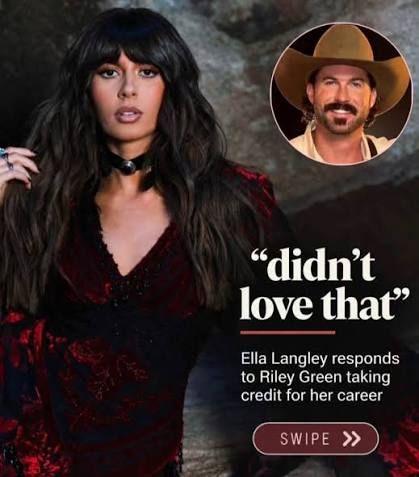
Country music listeners have always appreciated a plainspoken answer. In a tradition built on memorable voices and stories that sound true to life, a few carefully delivered words can leave a stronger impression than a lengthy explanation. That helps explain why Ella Langley’s apparent response to Riley Green has attracted attention: it touches on something audiences understand well—the importance of receiving fair recognition for your work.
Ella Langley responded to a fan that asked her how she felt about Riley Green “taking credit” for her success, according to reports covering a recent Instagram Live exchange. Her reported answer was brief: “No, didn’t love that, but typical.” Coverage of the livestream connected those words to a viewer’s question about Green’s comments on The Voice, although Langley did not explicitly name him in the reply. That distinction matters when considering what the exchange actually establishes.
The discussion began with Green recalling their professional history while trying to persuade sister duo Ferryn & Brinkley to join his team on the singing competition. He mentioned taking Langley on tour and referred to her subsequent success. Some viewers heard an implication that he deserved credit for her rise; others understood the remarks as an affectionate acknowledgment of a successful former touring partner. The words prompted different interpretations, and they do not, by themselves, settle his intention.
For listeners familiar with “You Look Like You Love Me” and “Don’t Mind If I Do,” the conversation carries an additional layer. Langley and Green’s shared recordings are an established part of their musical connection, giving fans a reason to care about how each artist discusses that partnership. Their collaborations and touring history provide the background to this latest exchange, rather than proof of any private disagreement.

From a musical perspective, a successful duet depends on more than placing two recognizable names beside a song title. Each singer must contribute a distinct presence while listening closely enough to make room for the other. Phrasing, timing, restraint, and the character of a voice all shape what the audience remembers. Listeners may discover an artist through a collaboration, but continued interest depends on what that performer brings to the microphone.
That is why the question of artistic recognition resonates beyond this particular story. Many older readers will recognize the experience from their own working lives. A helpful introduction, a generous opportunity, or an experienced colleague’s encouragement can make a lasting difference. At the same time, the person receiving that opportunity still has to prepare, perform, and earn the confidence of others. Both contributions deserve thoughtful acknowledgment.
Langley’s reported reply may have been brief, but the discussion around it invites a more considered look at how country music careers are described. Fans can value Green’s role as a collaborator and touring partner while also recognizing Langley’s individual contribution. They can also resist treating an ambiguous public exchange as a complete account of a professional relationship.
For an audience that cares most about the music, the enduring question concerns the voice behind the achievement. Opportunities help a performer reach the stage. What happens once the song begins—the conviction, the musical judgment, and the connection with listeners—is what gives that performer a place in people’s memories.