Introduction
When Alan Jackson Sang for His Father, He Sang for All of Us
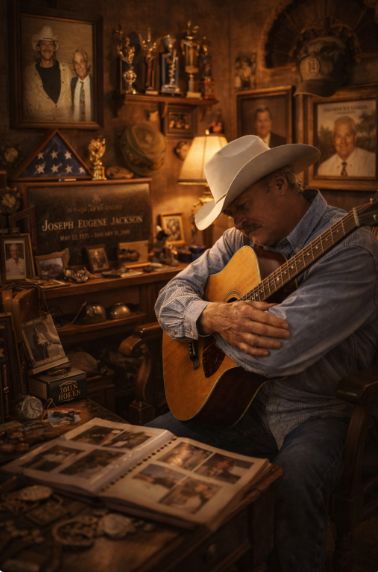
There are certain songs that do not simply fill a room—they quietly transform it. They reach past applause, past performance, past even the singer who first brought them to life, and settle somewhere deeper. Alan Jackson’s “Drive (For Daddy Gene)” is one of those songs. It does not arrive with grand theatrical force. It does not need to. Instead, it opens like memory itself: gently, honestly, and with the kind of emotional truth that catches people off guard. What begins as one man honoring his father soon becomes something far more universal. It becomes a doorway into childhood, into family, into the ordinary moments that time later reveals as sacred.
“WHEN ALAN JACKSON SANG ABOUT HIS FATHER, THE ROOM BECAME EVERYONE’S CHILDHOOD”
That line feels powerful because it captures exactly what happens when Alan Jackson performs this song. The stage may still be lit, the band may still be in place, and thousands of people may still be seated in front of him—but the emotional setting changes almost immediately. The concert hall disappears. In its place come front porches, dirt roads, fishing boats, old pickups, summer air, and the sound of a parent’s voice that once seemed so ordinary and now feels irreplaceable. Alan Jackson has always possessed a rare ability to make large spaces feel intimate, but with “Drive (For Daddy Gene),” that gift becomes especially moving.
Part of what makes the song so enduring is that it is built not on exaggeration, but on recognition. Jackson does not describe a heroic fantasy. He gives us something much more meaningful: the texture of real life. He sings about learning, about growing up, about being shaped by someone whose influence often seemed quiet at the time but later proved permanent. That is why the song lands so deeply with older listeners. It reflects a truth many people come to understand only with age—that the moments which form us most completely are often the simplest ones. A drive in a boat. A ride in a truck. A lesson given without ceremony. A father’s presence, steady and unspoken, becoming part of who we are.
What makes Alan Jackson especially suited to this material is the sincerity he brings to it. He has never sounded like a performer trying to manufacture emotion. He sounds like a man remembering. That difference matters. In a world where sentiment is often pushed too hard, Jackson’s restraint is what gives the song its strength. He trusts the material. He trusts the listener. And because of that, people do not merely hear the story—they enter it. They begin to think of their own fathers, or grandfathers, or the person who first taught them how to stand, how to work, how to keep going. The song becomes personal without ever losing its simplicity.

There is also something deeply significant about the way Jackson often introduces the song with a few brief childhood reflections. Those spoken moments matter almost as much as the music itself. They lower the emotional distance between artist and audience. In those seconds, Alan Jackson is no longer just a country legend. He is a son. A man remembering the one who guided him. And that humanity opens the door for everyone else in the room to do the same. Suddenly, the audience is no longer watching from a distance. They are participating in an act of remembrance.
For older, thoughtful listeners, this is where “Drive (For Daddy Gene)” becomes more than a favorite country song. It becomes a vessel for gratitude, grief, tenderness, and reflection. It reminds them that the people who shaped us never fully leave. Their words remain in our choices. Their lessons remain in our habits. Their love remains in the smallest details of how we move through the world. Alan Jackson understands this, and he sings it without decoration, which is precisely why it hits so hard.
In the end, “WHEN ALAN JACKSON SANG ABOUT HIS FATHER, THE ROOM BECAME EVERYONE’S CHILDHOOD” is more than a striking phrase. It is a description of a rare musical moment when one artist’s memory becomes a shared human experience. And perhaps that is the highest achievement any song can reach—not just to be heard, but to help people remember who loved them first.