Introduction
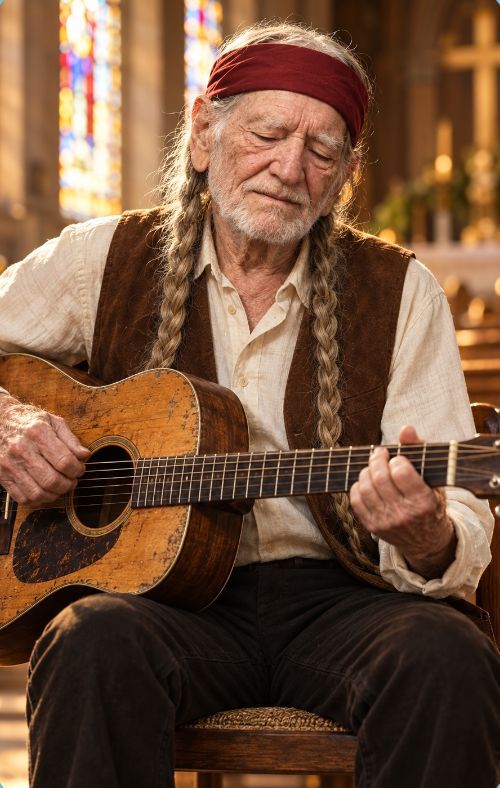
There is something fitting about Willie Nelson approaching one of life’s greatest mysteries with the same unhurried honesty he brings to a song. His voice has always made room for uncertainty—for the unfinished thought, the lingering sorrow, the hope that survives disappointment. When Willie Nelson shares why he believes in reincarnation, the appeal lies in that familiar combination of plain speech and thoughtful reflection. His explanation begins with a very human observation: learning how to live may take more than a single lifetime.
In an interview featured by PBS American Masters, Nelson described his belief that people have lived before and will return again. His reasoning was characteristically direct: “I don’t think anybody could be expected to get it right in one time through.” He compared the process to moving through school, with lessons to learn and tests to repeat. The humor in that comparison makes a large spiritual question feel surprisingly approachable. For Nelson, reincarnation offers a way to understand human imperfection and the continuing work of becoming wiser.
That belief grew alongside a religious upbringing and a willingness to ask questions. Speaking with Terry Gross, Nelson recalled the importance of gospel music and the Bible in his childhood. He also explained that curiosity about other faiths led him to libraries and to writers including Kahlil Gibran and Edgar Cayce. Their discussions of reincarnation helped him develop an understanding of life as an ongoing education. His account reveals a spiritual outlook shaped by reading, reflection, and the desire to understand experiences beyond his own.
For listeners, this provides an interesting way to consider the emotional character of his music. Nelson’s singing often seems to understand how slowly people change. A line can arrive slightly behind the beat, as though the thought needs another moment before it can be spoken. His restrained delivery allows regret, tenderness, and acceptance to coexist without forcing a tidy resolution. Heard through the lens of his beliefs, that patience takes on another meaning: perhaps a person’s unfinished work deserves compassion.
His reflections also carry the weight of loss. In a 2023 Parade interview, Nelson connected his thoughts about mortality with the experience of seeing friends come and go. Such remarks give his belief a personal setting. Questions about what follows death become especially intimate when familiar voices fall silent and ordinary places begin to hold extraordinary memories.

Listeners need not share Willie Nelson’s belief in reincarnation to find something moving in his explanation. The schoolroom comparison leaves room for mistakes, effort, and another opportunity to learn. For anyone looking back on decisions they would change, that idea can carry considerable emotional force.
Perhaps this is why his words feel so closely connected to his artistry. Nelson has a gift for making difficult subjects feel possible to approach. He does not need an elaborate argument to invite reflection. A little humor, a few plain words, and a patient voice are enough to leave us considering a hopeful possibility: that the lessons of a life may have meaning beyond what we can presently see.