Introduction
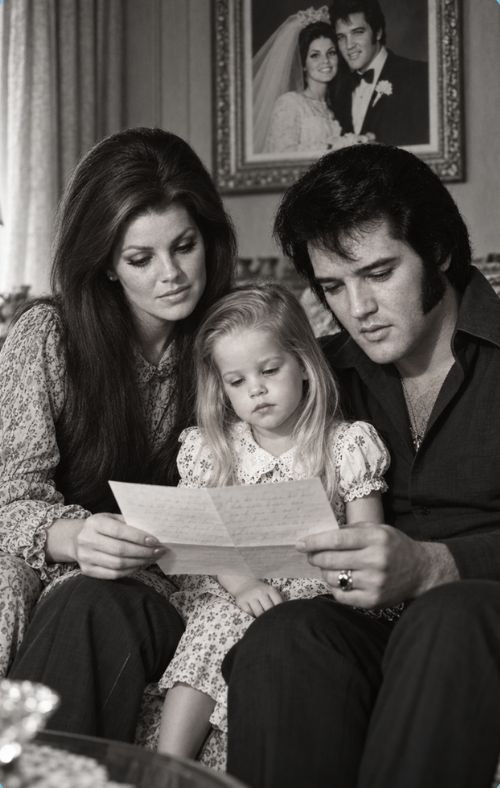
For generations, Elvis Presley has belonged to the world. His voice accompanied first dances, long journeys, quiet evenings, and moments people still remember with remarkable clarity. Yet the man whose recordings made millions feel understood could be far more difficult to understand at home. For Priscilla Presley, life behind the gates of Graceland meant knowing a person whose public warmth and private contradictions did not always fit comfortably together.
The phrase “The Hidden Letters of Elvis” suggests a dramatic discovery: a forgotten bundle, a locked drawer, perhaps a message waiting decades to be read. But the documented story deserves more careful treatment. In public recollections, Priscilla has described reading correspondence that unsettled her confidence in their relationship. Reporting on her appearances records her discussing letters from other women, as well as correspondence involving Elvis’s former girlfriend, Anita Wood. These accounts concern discoveries she later recalled publicly; they do not establish a newly unearthed collection of secret letters at Graceland.
That distinction leaves us with a story compelling enough on its own. Imagine the emotional distance between hearing a beloved voice on the radio and trying to understand the person who possesses it. An audience receives a performance shaped into a few memorable minutes. A family lives with the waiting, the uncertainty, and the conversations that cannot be resolved before the record ends. For Priscilla, a letter could introduce questions that admiration alone could never answer.
In a 2025 public appearance, she again described how reading fan mail had brought painful information into view. Her recollection offers a revealing glimpse of the pressure surrounding their marriage: correspondence that represented devotion from the outside could carry distress into the household. It is a small, ordinary detail with considerable emotional weight. An envelope requires no dramatic setting to change how someone sees a relationship.
For listeners who have grown older alongside Elvis’s music, this history may encourage a more thoughtful appreciation of his recordings. His interpretations often make longing sound immediate and regret sound deeply personal. That expressive gift remains powerful. Still, a convincing performance should never be treated as a private confession. We cannot assign a particular recording to a particular letter without evidence. What we can appreciate is the extraordinary ability of his voice to give emotional shape to experiences his listeners recognized in their own lives.

Priscilla’s recollections also invite us to consider the difficult work of remembering someone honestly. Affection does not erase disappointment, and disappointment does not necessarily erase affection. A shared history can contain tenderness, jealousy, loyalty, and the gradual recognition that love alone cannot settle every question. Readers who have lived through complicated relationships will recognize that tension without needing sensational details.
Then there is Lisa Marie Presley, whose perspective deserves its own space. The suggestion that these letters “shaped her life forever” goes beyond what the cited accounts establish. Her experience should not be reduced to an assumed consequence of correspondence between adults. Graceland’s announcement of her memoir, From Here to the Great Unknown, instead emphasizes the importance of hearing her own story, completed with the help of her daughter, Riley Keough.
Perhaps the most moving reason to revisit this chapter is that it brings the Presley family into human focus. Beyond the gates stood people trying to understand one another while the world watched an idealized picture. The letters matter because of the questions they raised about trust, belonging, and the person behind the celebrated voice. Those questions offer a quieter, more lasting kind of fascination—one that stays with us after the music fades.