Introduction
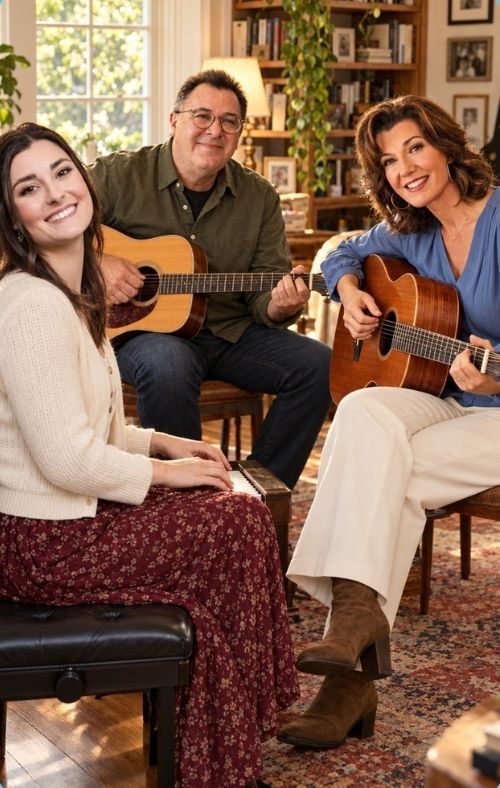
Before Vince Gill and Amy Grant could build a life together, there were four young lives to consider. That simple truth gives their wedding story a depth that photographs of famous people rarely capture. On March 10, 2000, the two singers married in an outdoor ceremony near Nashville, beginning a partnership that would ask something more demanding of them than exchanging vows: learning how to become a family.
Accounts of the occasion describe a rainy hillside and the sound of bagpipes. It is an unusually memorable setting for two artists whose voices could fill concert halls. Yet the enduring image is intimate: two people making a promise while the weather refused to cooperate. Looking back, the rain offers a fitting metaphor for the uncertainty of a new beginning—although no storm, however poetic, could simply wash away the past.
Their children brought that reality into focus. Gill had his daughter, Jenny, while Grant had Matthew, Millie, and Sarah from her previous marriage. Each child arrived with an existing family history, familiar routines, and relationships that remained important after the wedding. A new marriage could create a household; a sense of belonging would require time.
Grant later acknowledged that the children did not share the couple’s immediate excitement. Recalling the wedding photographs during an interview with Katie Couric, she described their solemn expressions with affectionate humor. That recollection makes the story more moving because it leaves room for feelings that a conventional celebrity romance might overlook. The adults were celebrating a future. Their children were still adjusting to what that future meant.
For readers who have raised children, remarried, or watched a family navigate change, this distinction will feel familiar. Happiness cannot be assigned to everyone on the same afternoon. Trust develops through ordinary experiences: being heard, having space to remember, and discovering that affection does not demand the surrender of earlier loyalties. These are reflections on the work of blending families, rather than claims about private conversations inside Gill and Grant’s home.
Their story also offers a thoughtful way to hear their music. “House of Love,” the duet they recorded before their marriage, brings their contrasting voices into a shared musical space. Grant’s warm, direct delivery and Gill’s clear tenor give the performance an appealing ease. With knowledge of their later life together, the title takes on an additional resonance: a house becomes meaningful through the people learning to live within it.
That does not make the recording a prediction of their marriage. Its pleasure lies in the musical exchange itself—the way two distinctive singers can support each other while retaining their individual character. For an older listener, that quality may be especially rewarding. There is reassurance in hearing harmony emerge without either voice having to disappear.
In a later interview, the couple spoke candidly about the challenges of bringing their families together and the unifying place of their daughter, Corrina, in the years that followed. Their account suggests a gradual process, shaped by kindness and adjustment, rather than an instant transformation at the altar.
Perhaps that is why the rainy wedding remains such a compelling introduction to their shared story. The ceremony marked a beginning; the family took longer to grow. When you listen to Vince Gill and Amy Grant together, there is something quietly affecting about that knowledge. Behind the polished harmonies stands the patient, everyday work of making room for one another.