Introduction
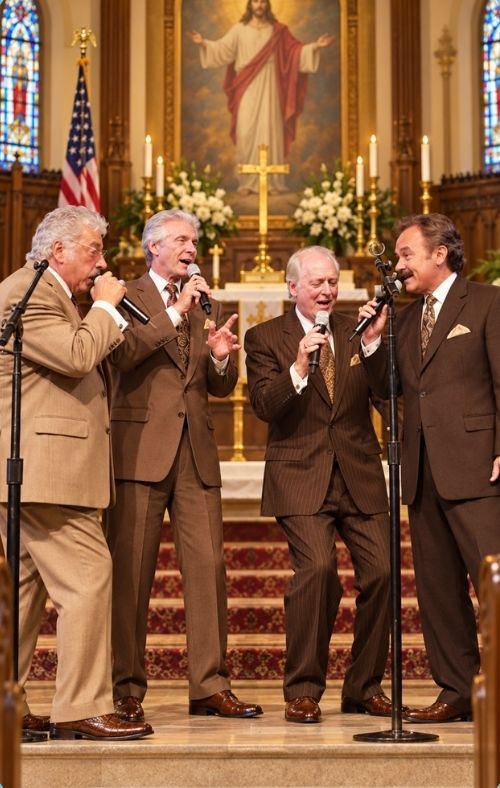
The Statler Brothers’ Greatest Surprise Was Hiding in the Harmonies All Along
For many listeners, The Statler Brothers bring back the sound of a familiar America: voices drifting from a kitchen radio, Saturday evening television, and songs that seemed to understand the people living just down the road. Their warmth made them easy to love. Yet that familiarity can also make us overlook how inventive they were. Behind the polished harmonies and friendly humor stood musicians who could turn an ordinary memory into a story—and an apparently cheerful song into something quietly unsettling.
Even their name contained a joke. No member had the surname Statler, and only Harold Reid and Don Reid were brothers. The name came from a brand of tissues, an unlikely beginning for an act that would become an enduring presence in country music. Their early sound drew on gospel quartet traditions, with Phil Balsley and Lew DeWitt completing the celebrated lineup alongside the Reid brothers. They joined Johnny Cash’s road show in 1964, beginning an association that lasted more than eight years.
To understand what made them special, listen again to “Flowers on the Wall.” Written by Lew DeWitt and recorded in 1965, it carried the group beyond country radio into the pop audience. Its success established that these singers possessed something more distinctive than pleasing voices: they had a remarkable instinct for character. The narrator sounds determined to convince us that everything is perfectly satisfactory. But the more insistently he describes his solitary routines, the more we begin to hear the loneliness beneath his confidence.
That tension gives the recording its lasting appeal. The lively musical setting invites a smile, while the story leaves room for concern. For this listener, the humor feels like a protective habit, the sort people develop when admitting disappointment would be harder than making a joke. Older audiences may recognize that emotional language immediately. We have all known someone who answered a worried question with a cheerful remark that revealed very little—and somehow revealed everything.
The quartet’s arrangement makes that ambiguity especially effective. Harold Reid’s bass gives the sound weight and character, while the upper voices keep it buoyant. Between those extremes, the lead and baritone provide the shape that allows the words to remain clear. Each part contributes to a shared expression. Listen closely, and the apparent ease becomes evidence of careful balance: the singers know when to stand forward and when to let another voice carry the moment.
Their later repertoire offered a different kind of emotional recognition. “The Class of ’57” and “Do You Remember These” became important examples of their gift for songs about memory. These recordings invite us to consider the distance between youthful expectations and adult experience. A remembered name, an old custom, or a vanished entertainment can open an entire room in the mind. The pleasure comes with a little ache, because remembering also means acknowledging what time has carried away.
The music asks more of us than simple nostalgia. It encourages attention to ordinary lives: the people whose stories never become headlines, the friendships that change gradually, and the hopes that survive in unexpected forms. That is why The Statler Brothers remain rewarding company for a thoughtful listener. Their humor welcomes us in; their understanding of human vulnerability gives us a reason to stay.
Returning to their recordings today, we can hear the craftsmanship beneath the familiarity. The voices remain inviting, but the stories grow richer as our own experience deepens. What once sounded like an entertaining song may now feel like a conversation with someone who understands. Their greatest surprise was there from the beginning: within those reassuring harmonies lived a clear-eyed appreciation of how complicated an ordinary life can be.