Introduction
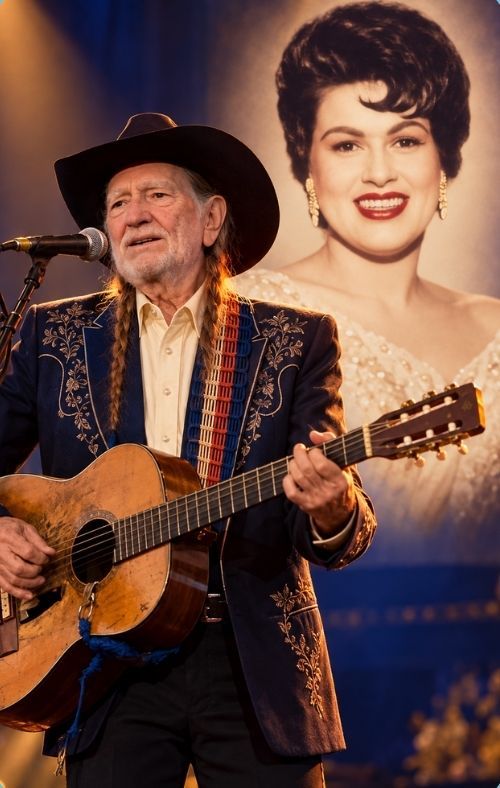
Some musical connections become more meaningful with the passing years. We return to them because they hold something familiar: the ache of an unfinished goodbye, the memory of someone whose voice once filled a room, or the quiet recognition that a song understands what we cannot quite explain. Willie Nelson in Memory of Patsy Cline invites that kind of reflection, bringing together two artists whose connection lives most powerfully in “Crazy.”
Written by Willie Nelson and made famous by Patsy Cline, “Crazy” remains an essential meeting of songwriting and interpretation. The Country Music Hall of Fame identifies the song as one of Nelson’s best-known early compositions and a defining part of Cline’s musical legacy. Their association gives any remembrance of her a foundation deeper than nostalgia: he supplied the words and melody, and she gave them a voice listeners would carry through their lives.
What makes the song so affecting is its emotional restraint. Its narrator recognizes the painful distance between hope and reality, yet the music never hurries that realization. The melody allows uncertainty to linger. Each phrase seems to approach a difficult admission slowly, as though speaking too quickly might make it harder to bear. For listeners who have lived through disappointment and learned to keep their composure, that measured movement can feel remarkably true.
Patsy Cline’s voice gives this vulnerability an extraordinary dignity. Listen to the way she shapes a phrase: a firm beginning, a sustained note, then a gentle release that leaves the feeling suspended. Her singing has strength, but she understands how much a small change in tone can communicate. The performance invites us to listen closely rather than overwhelming us with its sorrow. That balance helps explain why the recording rewards repeated listening.
Nelson’s musical character offers another way into the same emotional world. His conversational phrasing makes a melody feel like a thought forming in real time. As a matter of interpretation, the difference is fascinating: Cline gives “Crazy” a graceful, carefully held shape, while Nelson’s approach to singing often suggests someone quietly considering the meaning of his own words. Both styles leave room for the listener’s experience.
For an older audience, a remembrance of Patsy Cline may also awaken memories beyond the recording itself. A song can bring back a kitchen radio, a long evening drive, or a familiar face across a table. The details differ from one listener to another, but the emotional connection is personal. Music becomes part of the way we remember our lives, preserving ordinary moments that might otherwise slip away.
The lasting appeal of Willie Nelson in Memory of Patsy Cline lies in that meeting of artistic legacy and private memory. It encourages us to hear the song with fresh attention—to notice the patience of the melody, the clarity of its feeling, and the care in the voice that carries it.
A moving tribute does not need an elaborate story. Sometimes the strongest remembrance is simply to listen again. In “Crazy,” Nelson’s writing and Cline’s interpretation still meet with remarkable intimacy, reminding us how much human experience a few minutes of music can hold.