Introduction
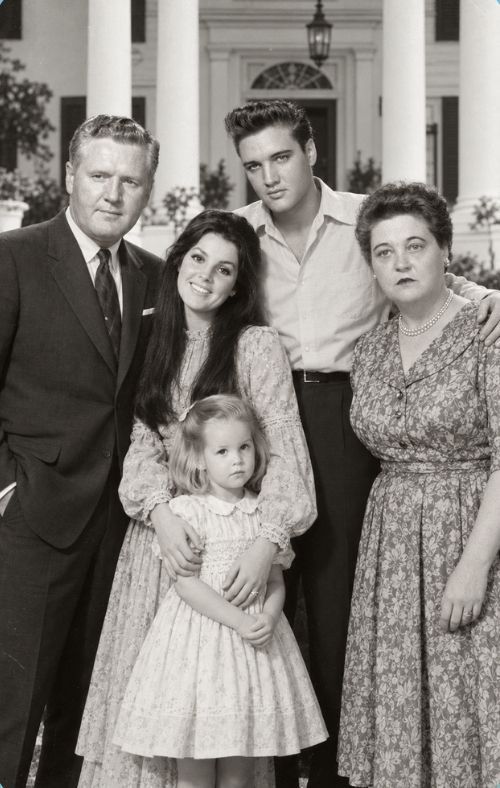
For generations of listeners, Elvis Presley has been more than a singer. His voice belongs to the rooms where they grew up, the records their parents treasured, and the songs that still bring an earlier chapter of life into focus. Yet behind that familiar voice lies a family history far more intimate than the public image of the King of Rock ’n’ Roll. To follow the Presley family tree is to encounter parents, children, and grandchildren whose lives unfolded beneath an extraordinary name—and whose losses could never be softened by fame.
The story begins in a small, two-room house in Tupelo, Mississippi, on January 8, 1935. Gladys and Vernon Presley welcomed Elvis into the world, but his twin brother, Jesse Garon Presley, was stillborn. Elvis would grow up as an only child, although his birth belonged to a pair. That simple fact gives the beginning of his story an enduring sadness: before the applause, before the records, before anyone imagined Graceland, the family had already experienced a devastating absence.
It is tempting to treat that loss as an explanation for everything Elvis later became. But a thoughtful account must leave room for what we cannot know. His music does not provide a diary of every private wound. What it does offer is a remarkable emotional range: confidence and vulnerability, celebration and longing, sometimes within the same performance. For listeners who have lived long enough to understand how closely joy and sorrow can coexist, that range remains one of his greatest gifts.
Gladys Presley occupied a central place in his life. Her death on August 14, 1958, when Elvis was only 23, brought grief into the middle of his extraordinary rise. Graceland’s historical account records that the Blackwood Brothers sang “Precious Memories” and “Rock of Ages,” two of her favorite hymns, at her funeral. The detail is quietly revealing. At a moment when celebrity offered little comfort, the family turned toward familiar sacred music—the kind that gives mourners something to hold when ordinary speech becomes difficult. graceland.com
The next generation carried that famous name into a different world. Lisa Marie Presley, the only child of Elvis and Priscilla Presley, grew up with a father whose public presence would continue long after his death. She eventually pursued her own work as a singer and songwriter. Listening to her invites a necessary distinction: family resemblance may attract our attention, but an artist deserves to be heard for her own phrasing, perspective, and emotional character.
Lisa Marie also became the mother of four children. Riley Keough and Benjamin Keough were born during her marriage to Danny Keough; Harper and Finley Lockwood, her twin daughters, were born during her marriage to Michael Lockwood. Benjamin died in 2020, and Lisa Marie died in January 2023. Those losses belong first to the people who loved them, even as the world recognizes their connection to Elvis.
Here, the family tree reveals its most striking echo: Elvis’s life began with a twin brother, and his only daughter later became the mother of twins herself. This is a documented family connection, moving enough without turning it into a prediction, a mystery, or a supposed family curse. At the beginning stands a brother who never had the chance to grow up. Generations later stand two sisters with lives and possibilities of their own.
Riley, Harper, and Finley also connect the family’s future to its most recognizable home. Graceland identifies Riley as the sole trustee acting for herself and her sisters in the family’s retained ownership interest in its operating entities. Behind that formal responsibility lies something more personal: preserving a place where public history and family memory occupy the same rooms.
For older listeners, perhaps this is what makes the Presley legacy so affecting. A beloved recording can seem untouched by time, while the family behind it continues to experience change, bereavement, and renewal. We can hear Elvis as he sounded decades ago; his descendants must live in the present.
The family tree therefore changes the way we approach the music. Behind the commanding performer was a son. Behind the inherited name was a daughter seeking her own voice. Beyond the familiar photographs are grandchildren entitled to shape their own futures. The records preserve the legend, but these relationships restore the human scale of the story—and make that unmistakable voice feel closer still.