Introduction
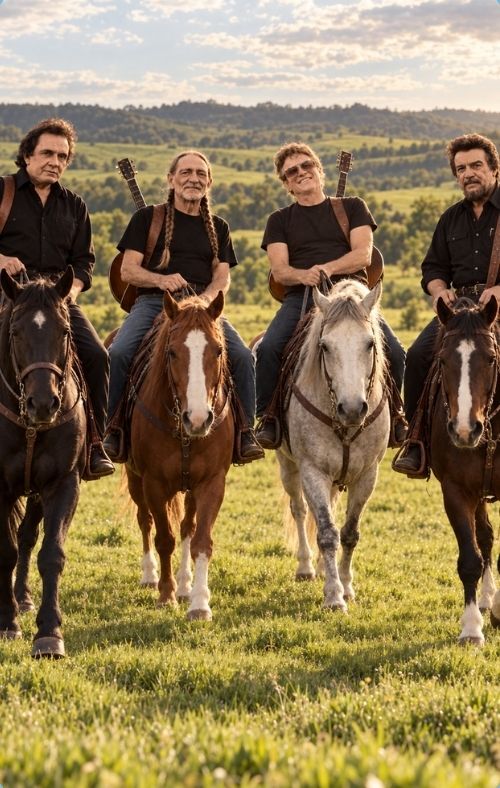
Some recordings grow more powerful because the years change the people listening to them. “Silver Stallion” by The Highwaymen belongs to that rare company. What once sounded like an invitation to ride beyond the horizon now carries another feeling: the precious possibility of hearing four unmistakable voices together again.
Released on Highwayman 2 in 1990, the song brought Johnny Cash, Willie Nelson, Waylon Jennings, and Kris Kristofferson together around a composition by Lee Clayton. Its imagery belongs to the great tradition of American songs about movement, independence, and the elusive promise of a life beyond ordinary boundaries. Yet these singers gave that imagery a particular weight. In their hands, the open road felt like somewhere they had already been—and somewhere they still needed to go.
For listeners who have followed these men through decades of records, their appeal has always extended beyond musical polish. Each possessed a voice with a recognizable character, shaped by choices, experience, and an individual way of telling a story. Together, they created a performance in which difference became strength. You never needed to wonder who was singing. Recognition arrived almost immediately.
Kris Kristofferson brings a weathered intimacy to the song. His delivery makes its restless dream feel personal, as though the singer is sharing a thought that has followed him through many quiet nights. There is something especially moving about the space between his modest vocal manner and the expansive world the words suggest. He allows the listener to discover the emotion rather than announcing it.
Waylon Jennings supplies a firmer edge. His voice carries the confidence of someone accustomed to choosing his own direction, even when the easier route lies elsewhere. Within this performance, that confidence gives freedom a tangible force. The journey feels less like a distant fantasy and more like a decision waiting to be made.
Then there is Willie Nelson, whose phrasing seems to understand the road’s uneven rhythm. He can make a familiar musical line feel newly considered, letting a phrase settle before moving gently ahead. His contribution adds warmth to the song’s defiance. Independence, through Willie’s voice, can sound companionable—a journey on which there might still be room for an old friend.

Johnny Cash brings the deep grounding presence that makes the quartet feel complete. His voice lends consequence to the surrounding imagery. The dream may be beautiful, but there is gravity beneath it: the sense that a person’s freedom matters because life offers only so much time to claim it.
These descriptions are a listening interpretation, but they help explain why “Silver Stallion” feels so enduring. The performance holds aspiration and experience in the same frame. Its singers make the desire to escape sound credible because their voices suggest an understanding of what people carry with them.
For older listeners, that balance can be particularly affecting. We know that an open road does not erase yesterday. We also know that the wish to keep moving—to remain curious, independent, and receptive to possibility—need not disappear with age.
The loss of Waylon Jennings, Johnny Cash, and Kris Kristofferson, with Willie Nelson becoming the quartet’s last surviving member after Kristofferson’s death in 2024, adds a poignant dimension to hearing them together. The recording preserves their musical companionship with a clarity that remembrance alone cannot provide.
Press play, and each voice returns in its own time. The years remain outside the song for a few minutes. Inside it, The Highwaymen still share the same horizon—and “Silver Stallion” still invites us to follow.